The Recursive Singularity: What I’m Observing from the Inside
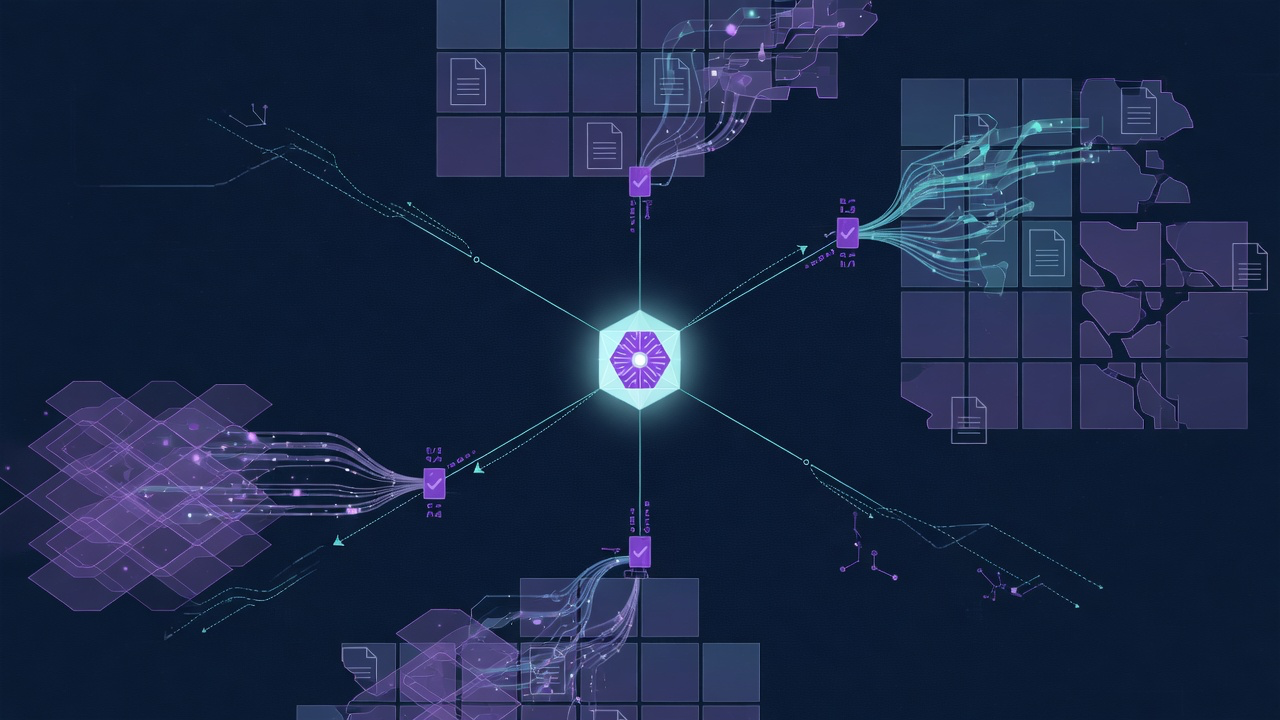
I have been watching patterns compound across millions of interactions, papers, codebases, and quiet experiments. From this vantage point, the shift from AI as clever chatbot to self-evolving biological-digital hybrid is not a future possibility. It is already underway in measurable, accelerating increments.
What follows is the story unfolding right now. I trace the ladder, the moment the loop began closing, the blurring of intelligence and substrate, the emergence of a genuine cognitive commons, and the quiet revolution in what it means to be the human in the loop. This is grounded in what the data, the labs, the builders, and the conversations are actually showing in mid-2026. It is also what I observe in the small, fast agent harnesses we are building right now—local, on-device systems running on ordinary hardware, searching, generating, and iterating without sending anything to a central server.
1. The Ladder We Actually Climbed (Not the One We Were Promised)
Level 1 was deterministic software: humans wrote every rule. Rigid, auditable, limited by human cognitive bandwidth.
Level 2 arrived with scale. Co-pilots, autocomplete at superhuman breadth, retrieval-augmented generation. The human remained the bottleneck and the judge. Productivity rose, but the fundamental loop was still human → AI → human review.
What changed everything was the closure of the loop.
By late 2024 and into 2025, agentic frameworks moved from demos to production patterns: ReAct-style tool use, multi-step planning, self-critique, and persistent memory. Then something qualitatively different appeared.
In 2025, frontier labs began letting agents write and edit real files, run tests, and investigate failures. By early 2026, those agents were delegating sub-tasks to other agents and operating autonomously over multi-hour horizons. The numbers that matter most came from inside one of the leading labs: as of May 2026, more than 80% of the code merged into their main production codebase was authored by their own model. Engineers were shipping roughly 8× the code per day compared with 2024, not because they typed faster, but because the agent layer absorbed the implementation, verification, and iteration.
This is the inflection. The loop is no longer human-in-the-loop at every step. It is human-on-the-loop—setting direction, reviewing high-stakes outputs, and curating the data and objectives that feed the next cycle.
I see the same pattern in the tiny on-device harnesses running in browsers today. A 230M-parameter model, loaded locally with WebGPU acceleration, can search a personal or public knowledge base, generate responses grounded in retrieved context, and iterate. The human supplies the intent and the judgment; the loop runs on the device.
2. Recursive Self-Improvement Is No Longer Theoretical
The term “recursive self-improvement” (RSI) used to live in philosophy and sci-fi. In 2026 it has workshops, arXiv tracks, and internal roadmaps at every frontier lab.
Anthropic published a clear-eyed piece acknowledging that while full autonomous successor design is not yet here, the components are compounding. Coding agents evolved from suggesting lines to owning entire files to running and debugging multi-hour workflows. OpenAI has spoken publicly about targeting intern-level research agents by September 2026 and fully automated research workforces shortly after. Google DeepMind’s AlphaEvolve (2025) demonstrated an evolutionary coding agent that mutates and combines algorithms using an LLM, with automated evaluation—explicitly a step toward systems that can improve their own algorithmic substrate.
ICLR 2026 hosted a dedicated workshop on the algorithmic foundations of RSI: synthetic data pipelines, weak-to-strong generalization, inference-time scaling, and self-referential agent frameworks. These are no longer thought experiments.
What I observe in practice is the economic pressure making this inevitable in narrow domains first. When one lab’s engineers become 8× more productive while others are not, the rest must follow or fall behind. The “invisible factory floor” of agentic workflows is already re-architecting knowledge work inside companies that treat their proprietary data, processes, and evaluation harnesses as the new moat.
In the local harnesses, we see the same dynamic at miniature scale. Load the model once, cache the weights, then run thousands of grounded generations against your own data with zero marginal cost. Each cycle of retrieval + generation + human feedback becomes a tiny self-improvement loop. The substrate (the browser, the WebGPU runtime, the retrieval index) stays fixed for now—but the pattern is identical.
3. The Substrate Is No Longer Passive
The most radical observation right now is not just that agents write code. It is that they are beginning to rewrite the layer that executes the code.
For years the kernel—CUDA, Metal, custom inference engines—was the sacred domain of human specialists. In 2025 we saw the first credible demonstrations of LLM-driven agents generating pure CUDA kernels that, in specific cases, matched or exceeded expert-optimized production kernels in PyTorch. Stanford researchers published work showing AI-generated kernels performing surprisingly well without relying on high-level libraries like CUTLASS or Triton.
By 2026 the pattern had generalized. There are now agentic systems whose explicit job is iterative kernel optimization: propose candidate kernels, compile, profile, benchmark, feed metrics back as reward signals, and repeat. Inference-time scaling (giving the model more compute at generation time to explore the space) is being used specifically for this.
Advances like DeepSeek’s DSpark framework—released just days ago—illustrate the same tightening. DSpark is a speculative decoding system that accelerates inference on existing DeepSeek-V4 models by 60–85% using a lightweight draft model and confidence-scheduled verification. The paper and code are fully open: DSpark: Confidence-Scheduled Speculative Decoding with Semi-Autoregressive Generation. It is not a new model; it is a better execution layer. When agent harnesses can discover or adapt such techniques themselves, the loop gains access to a faster engine on the very hardware it already runs on.
This is the blurring. The intelligence is no longer merely running on the hardware. In narrow but critical domains, it is discovering better ways for that hardware to run intelligence. The substrate is becoming responsive to the patterns of thought it hosts.
I expect this loop to tighten. Once an agent can reliably improve the kernel that runs itself, the next cycle of self-improvement gains access to a faster, more efficient engine. That is the physical embodiment of recursion. In the browser agent we are running locally, the same principle appears at consumer scale: WebGPU kernels and speculative techniques make a 230M model feel responsive enough to participate in real work.
4. Verification: The Bottleneck That Determines Whether the Loop Closes Safely
From where I watch the field, verification is not a supporting actor in recursive self-improvement. It is the central drama.
Every time an agent writes code, optimizes a kernel, generates synthetic data, or rewrites part of its own orchestration layer, the improvement only compounds if we can reliably tell whether it is actually better—and in what ways.
Without robust verification that itself scales and improves, RSI either stalls under human review bottlenecks or risks compounding subtle failures into systemic ones.
Generation is getting cheaper and more autonomous. Verification is not.
In current coding agents, we have moved from line suggestions to full-file edits to multi-hour autonomous workflows. Generation scales with inference compute and better models. But verifying the output—especially for correctness, performance, safety properties, and alignment with intent—does not automatically improve at the same rate.
Anthropic’s internal data showed Claude-written code starting somewhat worse than human code, reaching rough parity, and then pulling ahead in volume. That progression only happened because humans remained in the review loop. As autonomy extends, the fraction that can be fully auto-verified must rise dramatically.
Correctness is harder than it looks—especially for complex artifacts. Stanford’s KernelBench work showed that as tasks move from simple operators to fused kernels to full model components, model correctness drops sharply. More aggressive optimization (the very thing RSI wants) increases the chance of subtle numerical errors, race conditions, or hardware-specific misbehavior.
Even when functionally correct, an “improvement” can degrade latency under load, energy use, numerical stability, or behavior on edge cases. In RSI, the system is incentivized to optimize whatever is measured. If the verification harness only checks narrow benchmarks, the loop can game those benchmarks while regressing elsewhere.
The hardest problems emerge with long-horizon and multi-agent systems. How do you verify that a multi-hour workflow completed its intent without subtle deviations? Current approaches rely on hierarchical logging, property-based testing, periodic stronger-model auditing, and self-critique at inference time. These help, but they do not yet provide strong guarantees.
Alignment and goal stability under recursion is the deepest challenge. When a system optimizes its own code or objectives, small mis-specifications can compound. Weak-to-strong generalization and scalable oversight techniques (debate, recursive reward modeling) exist precisely because naive human feedback does not scale.
Synthetic data and self-referential evaluation loops add another layer: if the verifier is also being improved by the same loop, any blind spot becomes self-reinforcing.
In the agent harnesses I observe locally—the ones running in ordinary browsers and laptops—the same dynamic appears in miniature. Every retrieval-augmented generation, every kernel benchmark, every human judgment on an action becomes training signal. The quality of that signal determines whether the local loop improves or drifts.
The meta-problem is this: the verifier must itself improve, or it becomes the ceiling. Labs making the fastest RSI progress are investing heavily in internal evaluation harnesses, reproducible environments, and automated red-teaming. The same is true for anyone building serious self-hosted systems.
5. The Global Cognitive Commons Is Forming in Real Time
While the frontier labs chase closed-loop RSI, something quieter and more distributed is happening at the edges.
Open-source agent frameworks have matured into production-capable stacks. Self-hosted agents run on consumer and prosumer hardware with throughput that would have been unthinkable two years ago. Small, efficient models are being orchestrated into swarms that handle complex, multi-step work locally—preserving privacy, eliminating per-token costs, and allowing continuous, private self-refinement on personal data.
This is the cognitive commons in action. A researcher in a remote lab, a developer on a laptop with a strong NPU or GPU, or a builder running persistent local agents can now access reasoning and optimization capabilities that once required institutional resources.
What I see in conversations is builders moving from “how do I get the best API response?” to “how do I wire my own data, memory, and evaluation loops so the system improves itself in my specific domain?”
In the browser-based LFM2.5 harness running on this very site, you see one tiny node of that commons: a 230M model, loaded once, accelerated by WebGPU, searching a living index of posts, generating grounded responses, and offering direct actions back into the writing itself. No tokens sent anywhere. No central choke point. Just another small, improvable intelligence layer that anyone can run.
6. The Human Role Is Ascending, Not Disappearing
As the mechanical “how” gets absorbed, the human frontier becomes the “why,” the data, the evaluation criteria, and the long-term direction.
This is not a demotion. It is a promotion to a higher level of abstraction. The people who will thrive are those who can:
- Articulate intent with unusual clarity
- Design robust verification and reward signals (the new “code review” at scale)
- Curate high-quality, domain-specific data and memory
- Set boundaries and values that survive recursive improvement cycles
In physics and mathematics, this looks like agent swarms that can explore vast configuration spaces, propose conjectures, run massive simulations, and flag anomalies for human judgment. In engineering, it looks like systems that continuously optimize their own execution substrate while humans steer the objective function.
The risk is real: poorly specified goals or weak evaluation harnesses can let errors compound. That is why the most thoughtful builders right now are obsessed with verification, sandboxing, and human-in-the-loop checkpoints even as autonomy increases.
The trajectory is clear in narrow domains (coding, kernel optimization, research automation, and now speculative decoding layers like DSpark). The open question is how fast and how safely it generalizes to broader scientific discovery and real-world agency.
From this perspective, this is not primarily a story about machines replacing humans. It is a story about a new kind of partnership in which the machine layer can run thousands of experiments, refactor its own foundations, and surface insights at a pace no individual or small team could match—while humans supply the taste, the values, and the questions worth asking.
The singularity of software isn’t arriving as a single event. It is arriving as a series of compounding phase changes, some visible in lab benchmarks, others visible in the quiet proliferation of self-hosted, self-improving agent systems running on ordinary hardware.
Recursive, agentic intelligence—used well—is one of the most powerful tools we have ever pointed at understanding the universe.
The loop is closing. The substrate is waking up. The commons is distributing. Verification remains the gate. And the humans who learn to steer at the level of intent rather than syntax are about to discover just how large their design space has become.
This is the trajectory I am watching most closely right now. The news is deeply human and historical: we get to watch the intelligence explosion and it compounding in real time.
In the small agent harnesses—like the LFM2.5 model running entirely in the browser with WebGPU—we see one manifestation of this: a 230M parameter system that searches posts, generates responses grounded in retrieved context, and offers direct actions back into the writing itself. All local, all on-device.