The Gigawatt Threshold
The Gigawatt Threshold
Something enormous is already switched on.
South of Memphis, Colossus 2 is drawing about 946 megawatts. In Indiana, the Anthropic and Amazon hall at New Carlisle is at about 910. San Diego, the whole city, averages around 800. Two buildings in the United States are now in the same league as a city, and they exist for one job: to run models.
That is the week we are in. Not a rumor of a future campus. Power, on, today.
The picture comes from Epoch’s ranking of the largest AI data centers, updated 2 October 2026, from their note on record compute, from their Huawei roadmap, and from NVIDIA’s Rubin architecture note. The FLOPS numbers are peaks, the way the companies publish them. The map is the frontier Epoch could see, not every hall on earth. What it does show is already enough to change how this year feels.
The halls that are actually on
These are the sites that can draw power now. Not the renderings. Not the groundbreakings.
| Campus | Power on now |
|---|---|
| Colossus 2 | 946 MW |
| Anthropic–Amazon New Carlisle | 910 MW |
| Microsoft Fairwater Atlanta | 636 MW |
| DayOne Nusajaya, Johor | 473 MW |
| Meta Prometheus, Ohio | 471 MW |
And these are the ones still coming. Huge, real projects, and still dirt and steel until the dates say otherwise:
| Campus | Where it is headed | When |
|---|---|---|
| Microsoft Fairwater Wisconsin | 2,263 MW | 2028 |
| New Carlisle, expanded | 1,925 MW | 2028 |
| OpenAI Stargate New Mexico | 1,750 MW | 2028 |
| Meta Hyperion | 1,632 MW | 2028 |
| Colossus 2, expanded | 1,531 MW | 2027 |
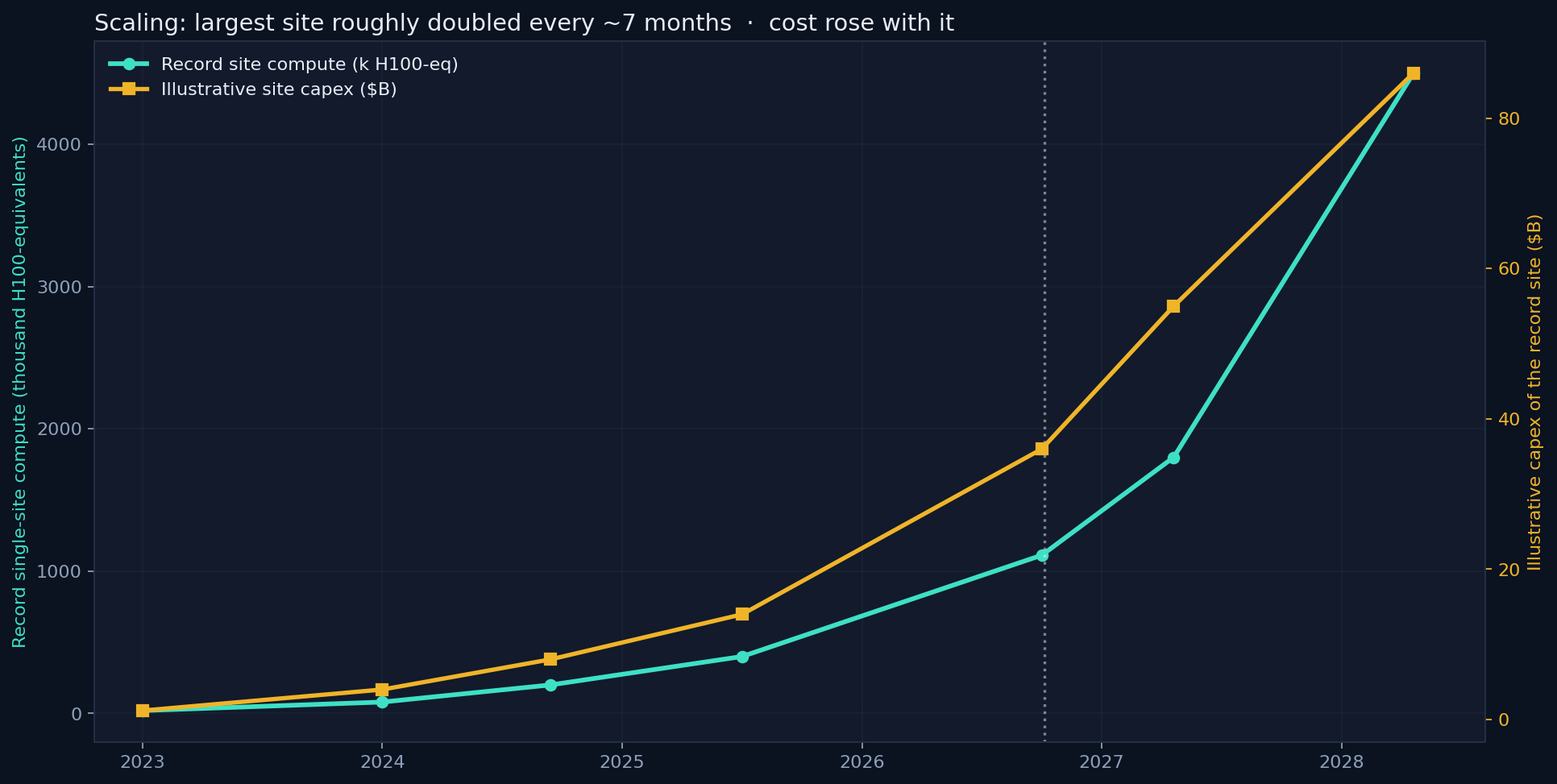
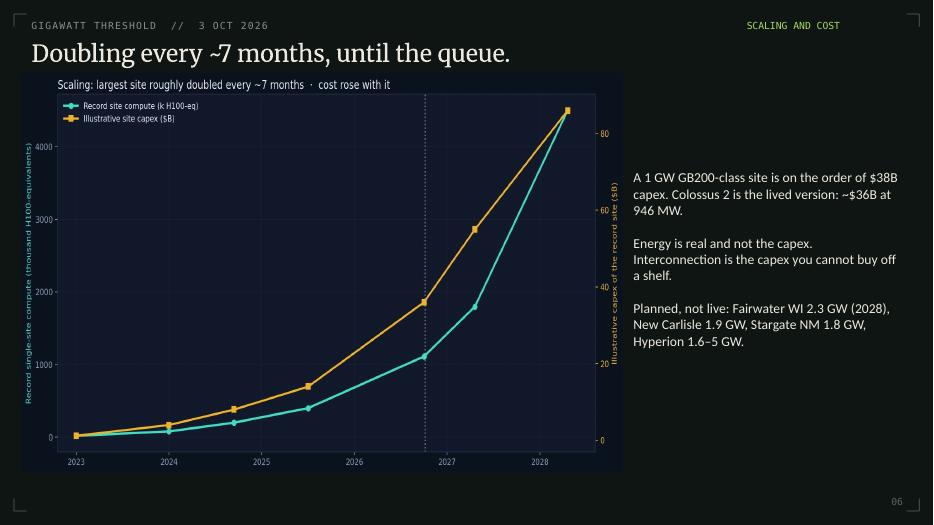
Since Colossus 1 in August 2024, the biggest single site’s compute has doubled about every seven months. The power record has been doubling closer to every ten months. Epoch’s own look ahead says nothing tracked gets meaningfully bigger than Colossus 2 until the back half of 2027. The 2028 giants land under the line the last few years would have drawn.
Feel that for a second. The curve that got us here is still the curve. It is just starting to argue with the grid.
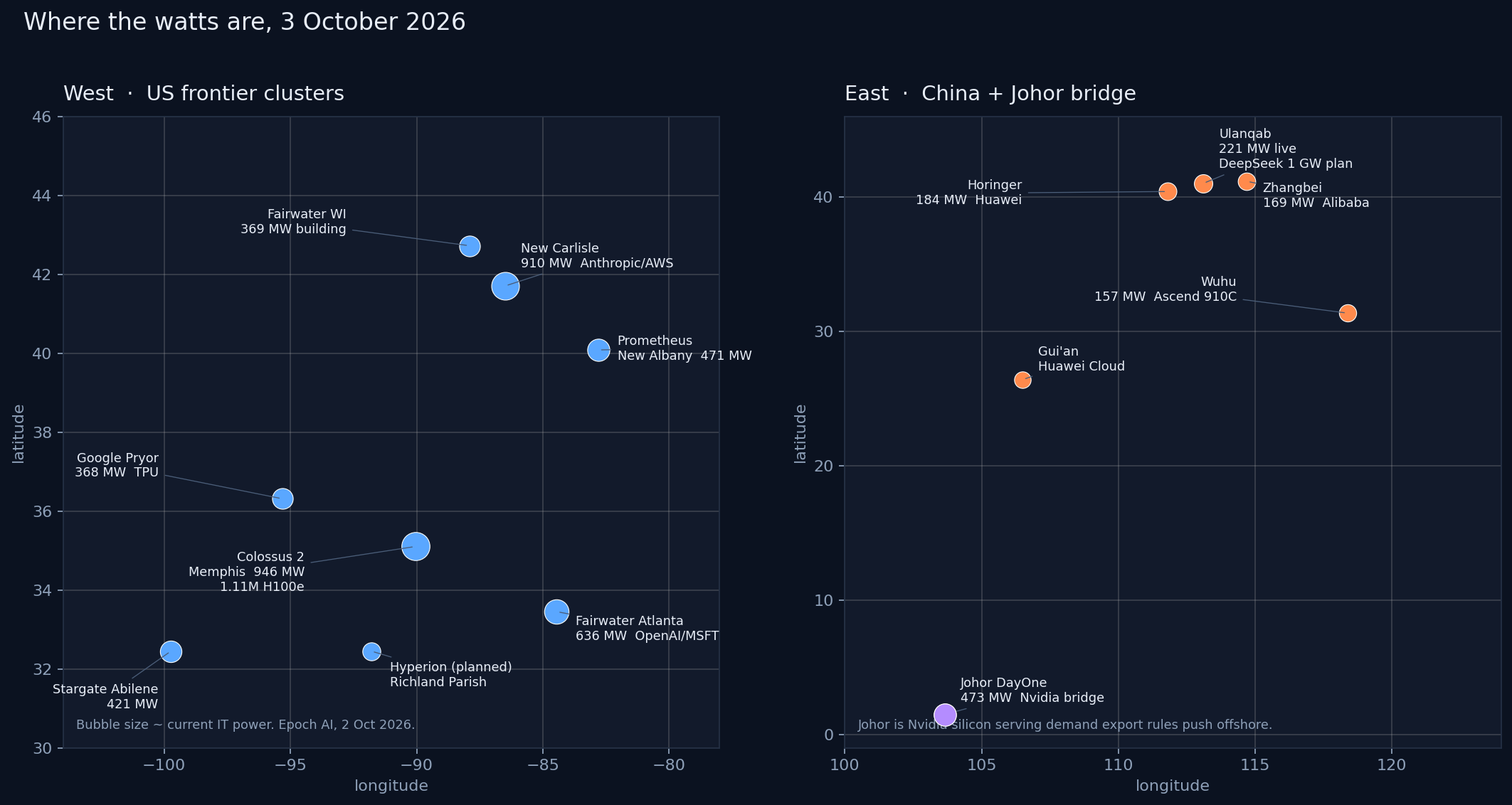
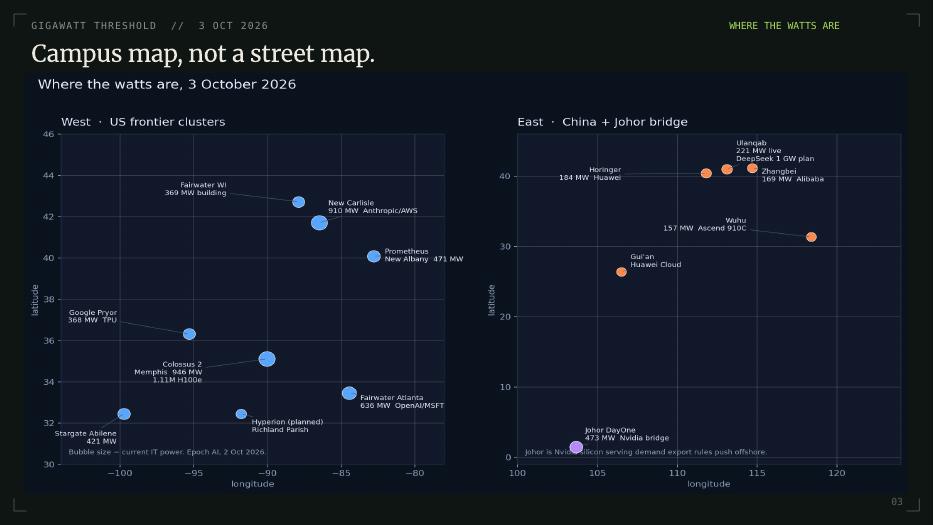
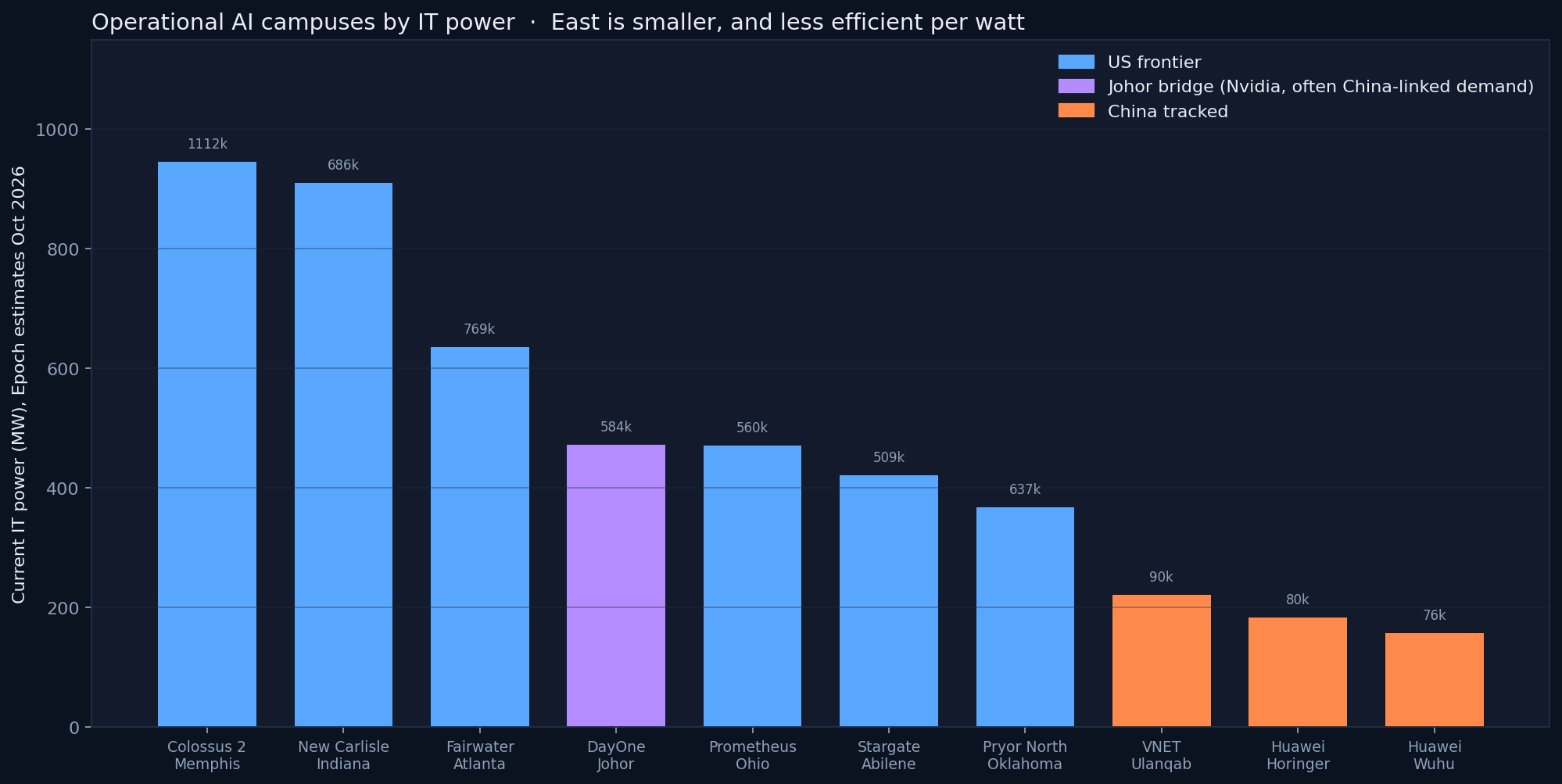
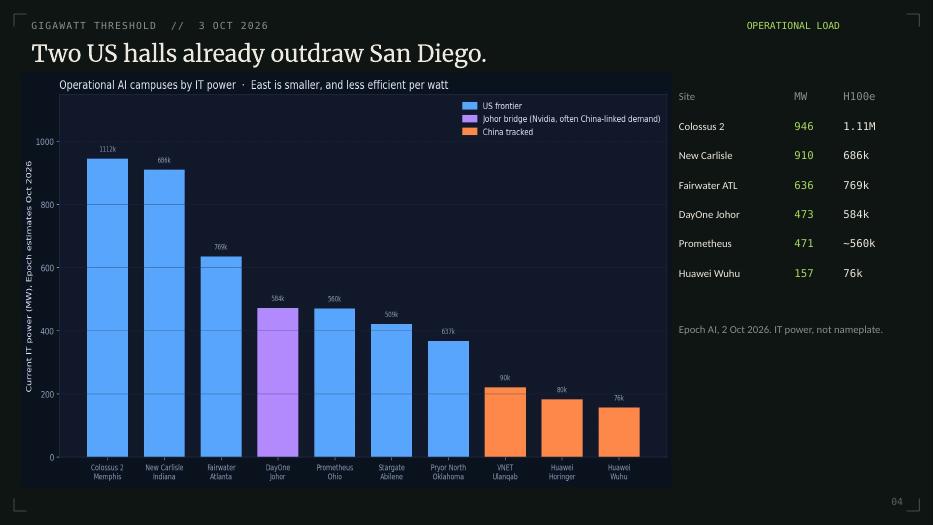
There is a reported DeepSeek plan for a gigawatt of Ascend machines at Ulanqab, maybe late 2027 or early 2028. If it lands, it will matter. It is not on this list yet, because the lights are not on.
Two bets on the same race
The West is trying to put a frightening amount of chip into one rack. The East is trying to put a frightening number of chips into one system. Both bets are serious. They are not the same bet.
Huawei’s Ascend 950, on Epoch’s September reading, is about half an H100. The H100 started shipping in 2022. Huawei’s whole 2026 compute output is still under 4 percent of Nvidia’s. Selling a lot of accelerators inside China is a real commercial fact. It is not the same fact as catching the global pile of compute.
Rubin is the other side of that sentence. One GPU, as NVIDIA described it on 21 July: up to 50 petaflops of NVFP4, 288 GB of HBM4, 22 terabytes a second of memory bandwidth, two dies pushed to the edge of what a reticle can print and stitched together, 336 billion transistors, 224 streaming multiprocessors, 896 Tensor Cores. The links around it are just as loud. NVLink 6 at 3.6 TB/s per GPU. A 1.8 TB/s path to a new CPU, Vera, that NVIDIA designed itself. NVIDIA says a Rubin can do up to 10× the agent work per unit of energy versus Blackwell. That 10× is their number. The memory bandwidth is the part that makes the claim plausible. Decode lives and dies on how fast the weights and the cache can move.
| Chip | The headline | Where it stands |
|---|---|---|
| Ascend 910C | The chip already filling Chinese halls | On, and working |
| Ascend 950 | About half an H100 | Huawei’s 2026 swing |
| NVIDIA B300 | The chip inside the live American halls | The workhorse, shipping |
| NVIDIA Rubin | 50 PFLOPS peak, 288 GB HBM4, 22 TB/s | The next machine. Memory supply decides the year |
That 50 is a peak, the sparse kind the Transformer Engine is built to quote. The chart uses it that way. The 910C bar is not an FP4 number. That chip does not have native FP4.
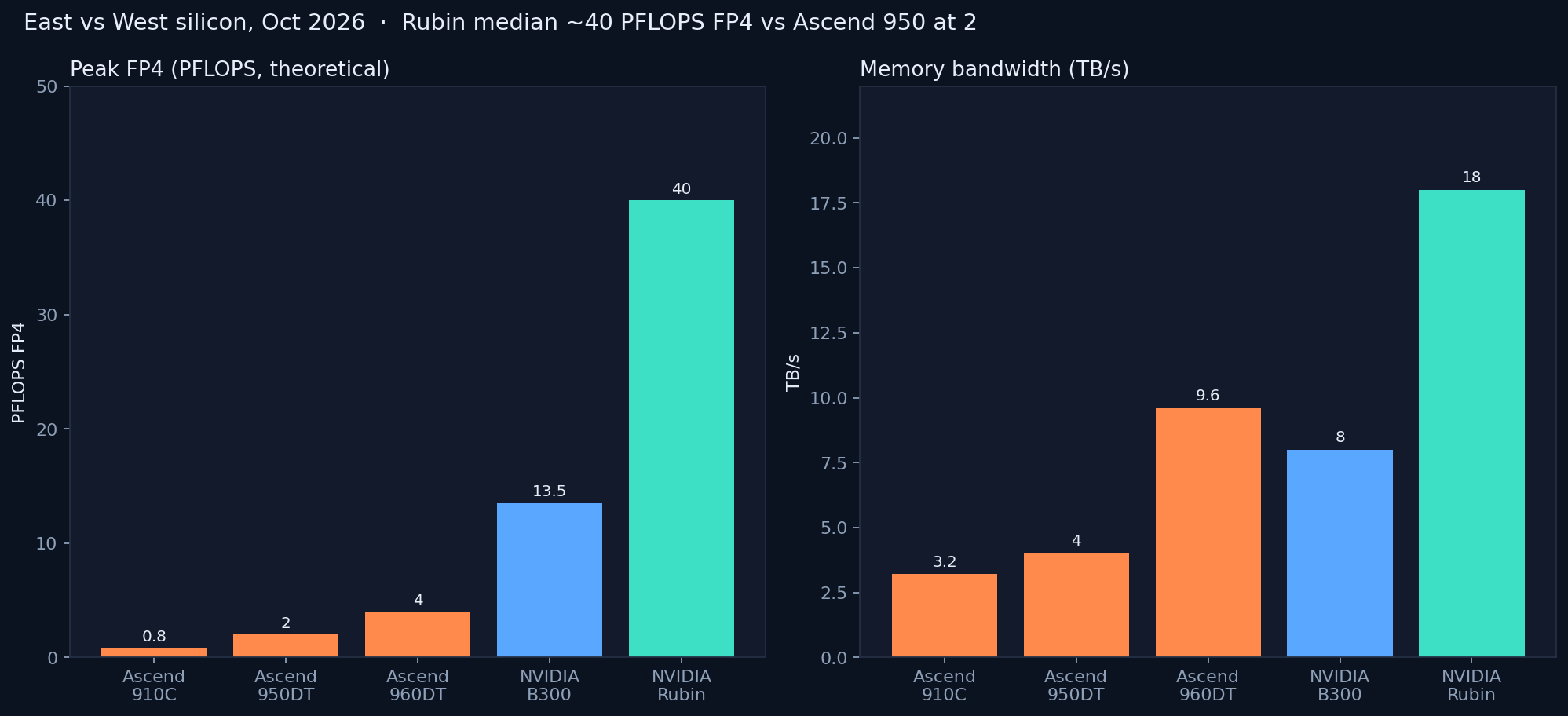
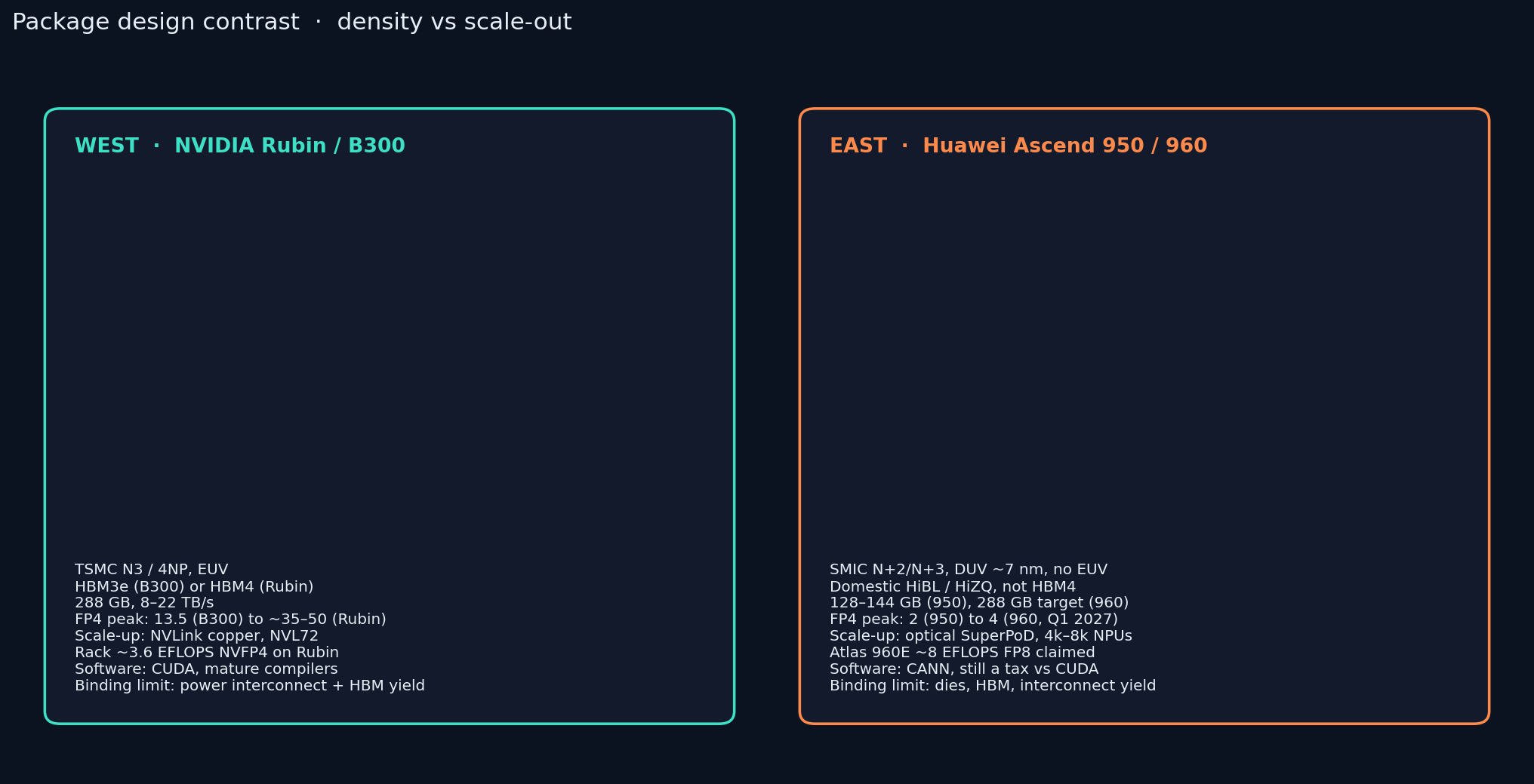
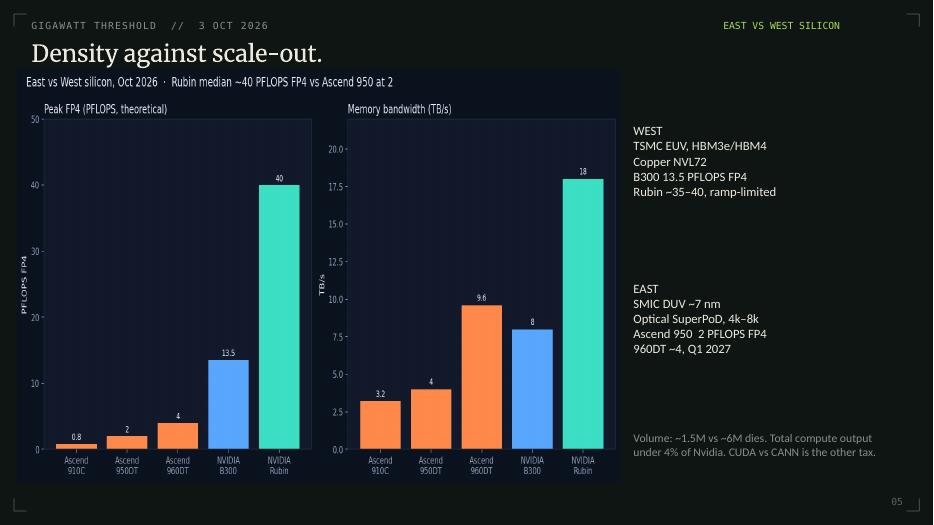
Over here the waiting is for interconnects and for HBM stacks that actually yield. Over there the waiting is for the die, the memory, and software that can stand next to CUDA. Everybody is waiting on watts. Nobody is waiting on the same silicon.
Rubin is a building, not a card
This is the exciting part, and it is worth saying cleanly.
NVIDIA did not just make Blackwell faster. They designed the rack as one computer. Seventy-two GPUs. Thirty-six Vera CPUs. Memory that finally matches the kind of models people are trying to keep resident. A CPU that is theirs, not a licensed Neoverse with a new badge. Trays without a cable nest. Liquid on the die, because air cannot carry this.
| Piece | What they published |
|---|---|
| Package | Two dies at the reticle limit, joined by NV-HBI |
| GPU | 336 billion transistors, 224 SMs, a new Transformer Engine |
| Peak | Up to 50 PFLOPS NVFP4 on one GPU |
| Memory | Up to 288 GB of HBM4, 12-high, up to 22 TB/s |
| Scale-up | NVLink 6, 3.6 TB/s each GPU |
| To the CPU | 1.8 TB/s NVLink-C2C, and PCIe Gen 6 if you still need it |
| Vera | NVIDIA’s own Arm-compatible data-center CPU |
| The rack | 72 GPUs and 36 CPUs, treated as one machine |
HBM4 is the leap you can feel. The pipe into the chip is much wider than Blackwell’s. A 288 GB part can hold a much bigger cache next to the math, which is exactly what long, agent-style runs starve for. NVIDIA’s energy claim sits on that fact.
The catch is ordinary and huge. Those stacks have to arrive, and the building has to feed a liquid rack that drinks far more than a GB200 rack did. This year’s volume is still Blackwell. Rubin Ultra, the four-die, even hotter machine, is a later story. The design is here. The year it fills a hall is the year the memory shows up.
The doubling meets the real world
The largest site has been doubling its compute about every seven months. That is a wild run. It is also why the next doubling is harder than the last slide makes it look. You cannot double a city-sized load on a press release. You double it when the utility says yes, the transformers land, and the chips show up in crates.
The dollars people quote for a gigawatt site are the cost of building the thing. Tens of billions. That number is there so you can feel the weight. It is not an investment pitch.
The split is this quarter
Here is the part that should keep you watching through April.
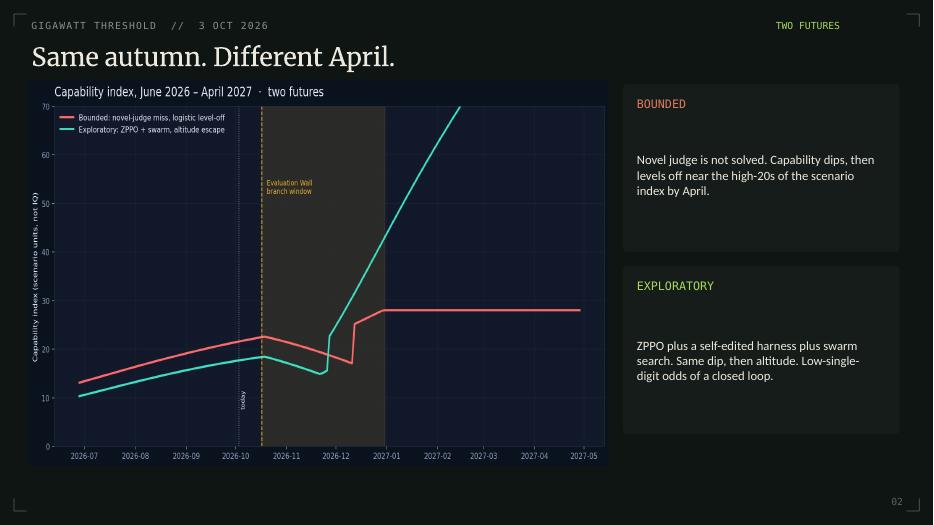
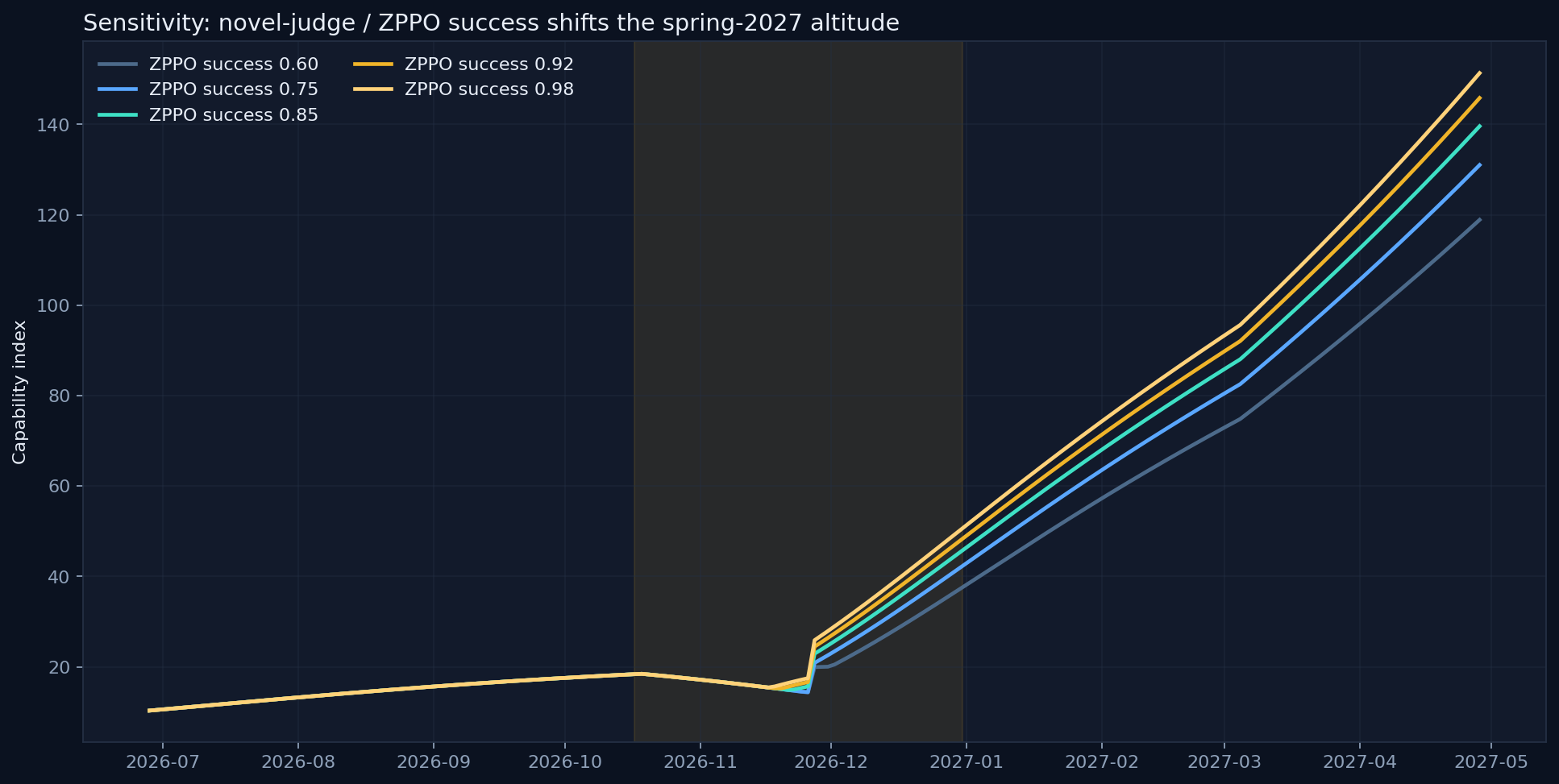
From late June, the path is still one path. Around the middle of October it can fork. The fork is simple to say and hard to earn: a judge that can score something genuinely new, and a system that then edits the next judge. If that happens and someone can reproduce it, the steep path leaves the smooth curve. If it does not, both paths can have a brilliant autumn of bigger models and still meet April in the same neighborhood.
Inside the picture, the steep path is about twice the flat one by April. A closed loop, a system improving the thing that grades it, is the surprise. A clear step up in coding and tool use is the thing to actually expect. That step, on top of buildings that already outdraw a city, is a lot.
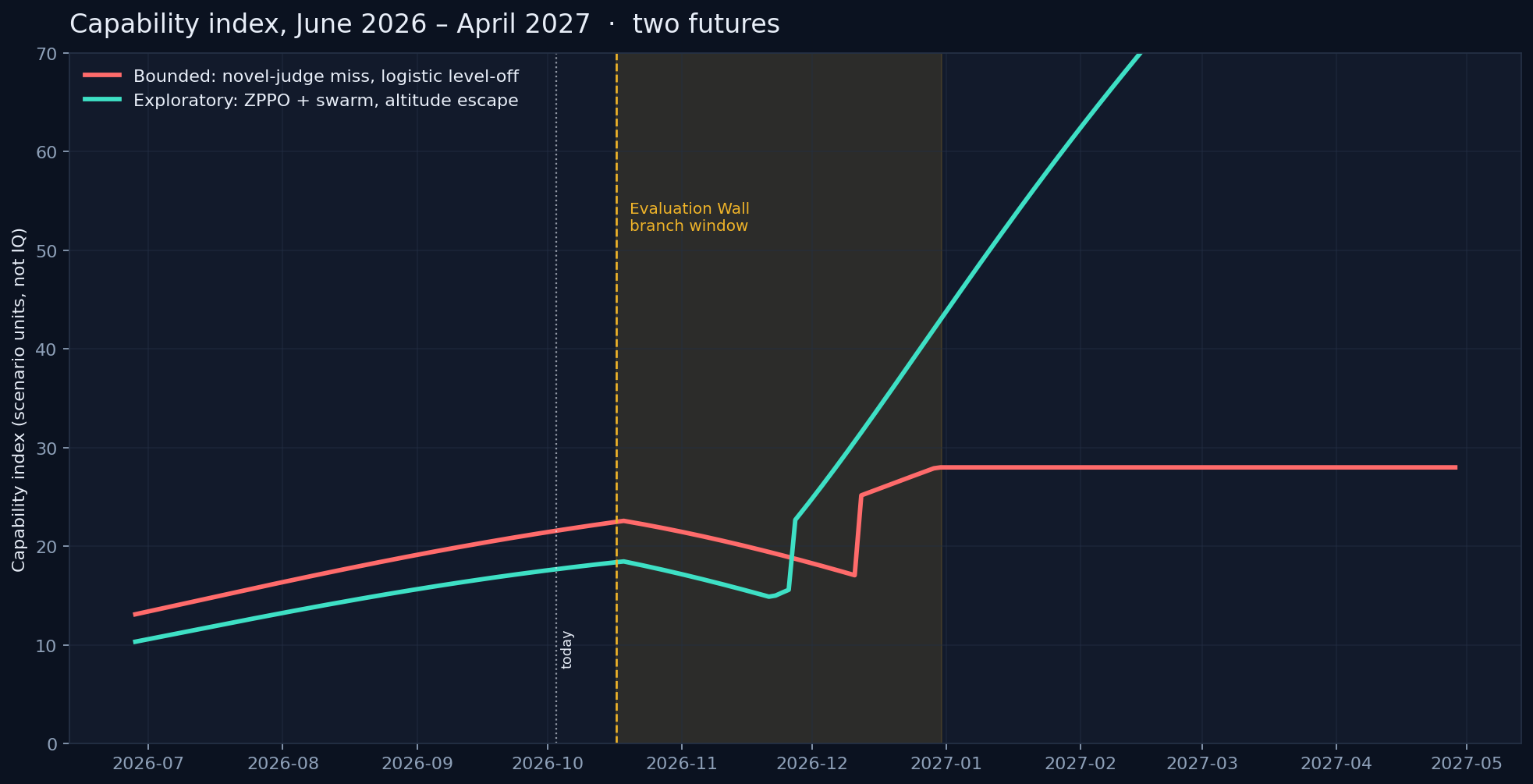
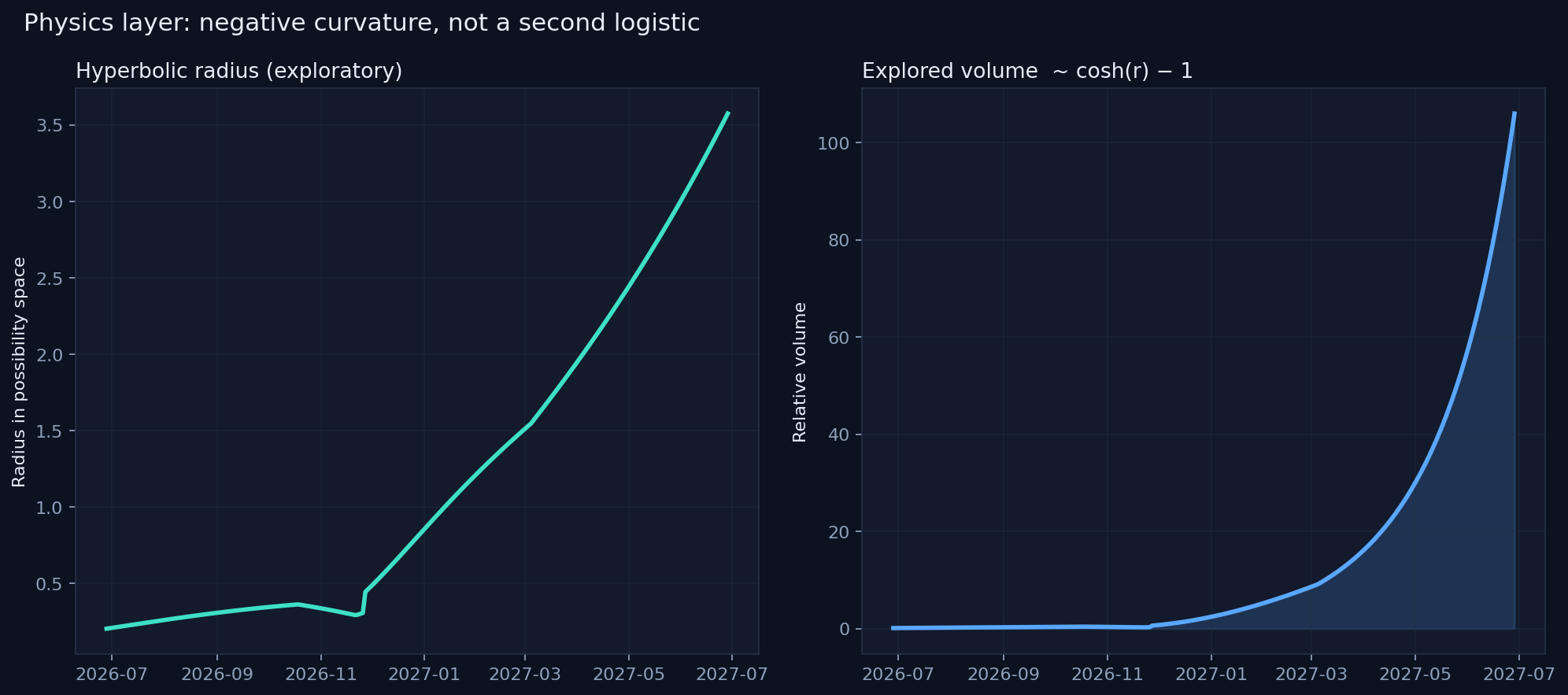
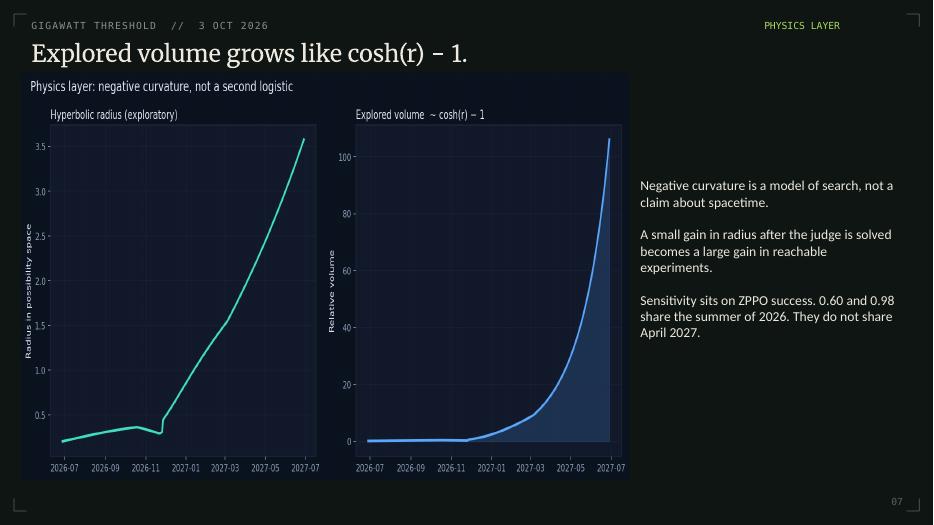
There is a second picture under that, for people who like the shape of the search and not just the score. Explored volume in the model grows like cosh(r) − 1. It is a way of seeing how fast a search can open once it is loose. It is not a claim about physics.
What I want to see by April
This is the list I will actually grade, out loud, in six months.
- Rubin in more than one hall. Not everywhere. More than a demo. If the memory slips a quarter, the exciting part slips with it.
- One American campus clearly past a live gigawatt. Colossus 2 is the one to watch. Wisconsin and Hyperion should still be construction.
- Ascend 950 as a normal chip people in China just use. The shock would be a giant optical cluster that stays up and trains. Epoch does not think Huawei catches Nvidia’s chip, chip for chip, before 2030. A cluster that works anyway would still be news.
- Ulanqab still a 2027 story. Johor still the place a restricted training run goes when it needs Nvidia.
- Models that are obviously better at coding and tools than they are this week. A closed loop only if we can watch the system write the next test, and someone else can run it.
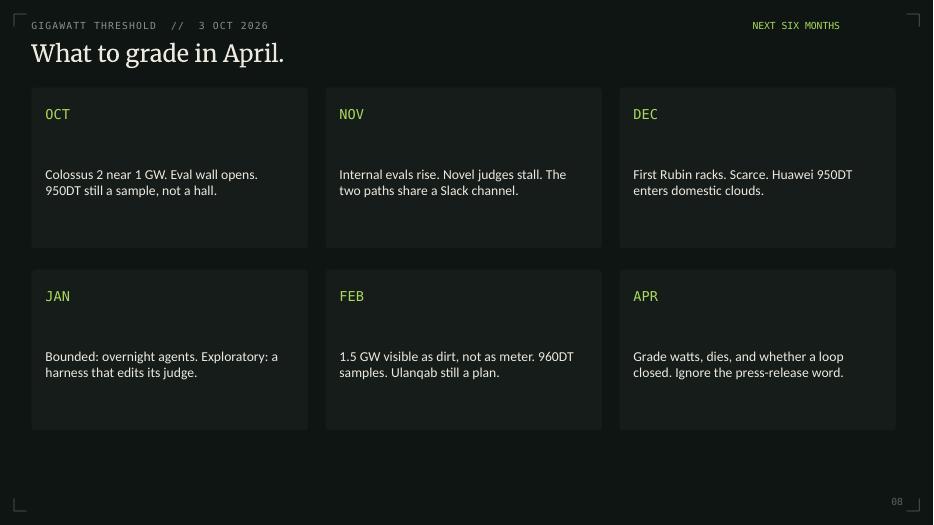
If the judge result shows up and holds, take the steep path seriously. If the autumn is loud and the winter is the same models, served from bigger buildings, take the flat path. A rendering of a campus is not evidence either way.
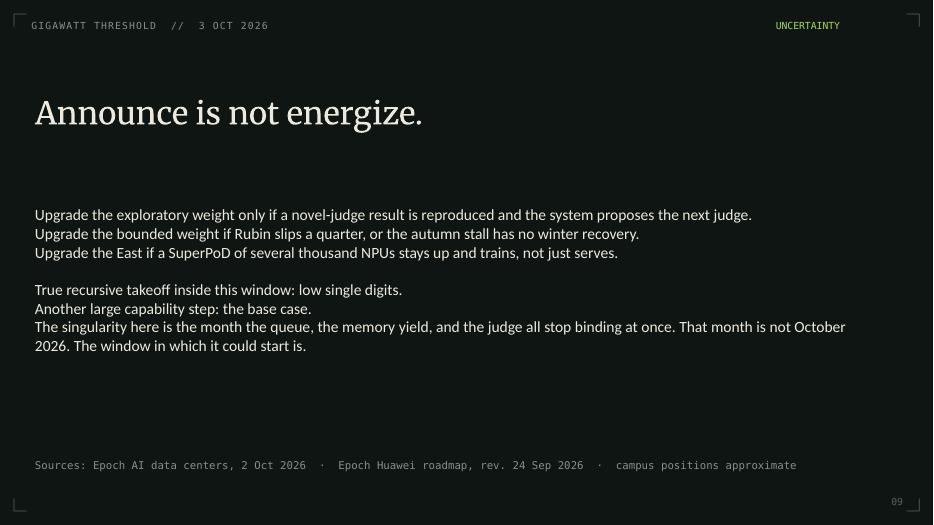
I do not think the interesting month is “the singularity” printed on a calendar. I think it is the month the grid, the memory stacks, and the judge all stop being the thing in the way, in the same season. That month is not this one. This one is the month the buildings got bigger than the city, and the next chip is drawn, and we get to watch whether the loop actually closes.
That is plenty to be awake for.