Signal vs Everyone Else
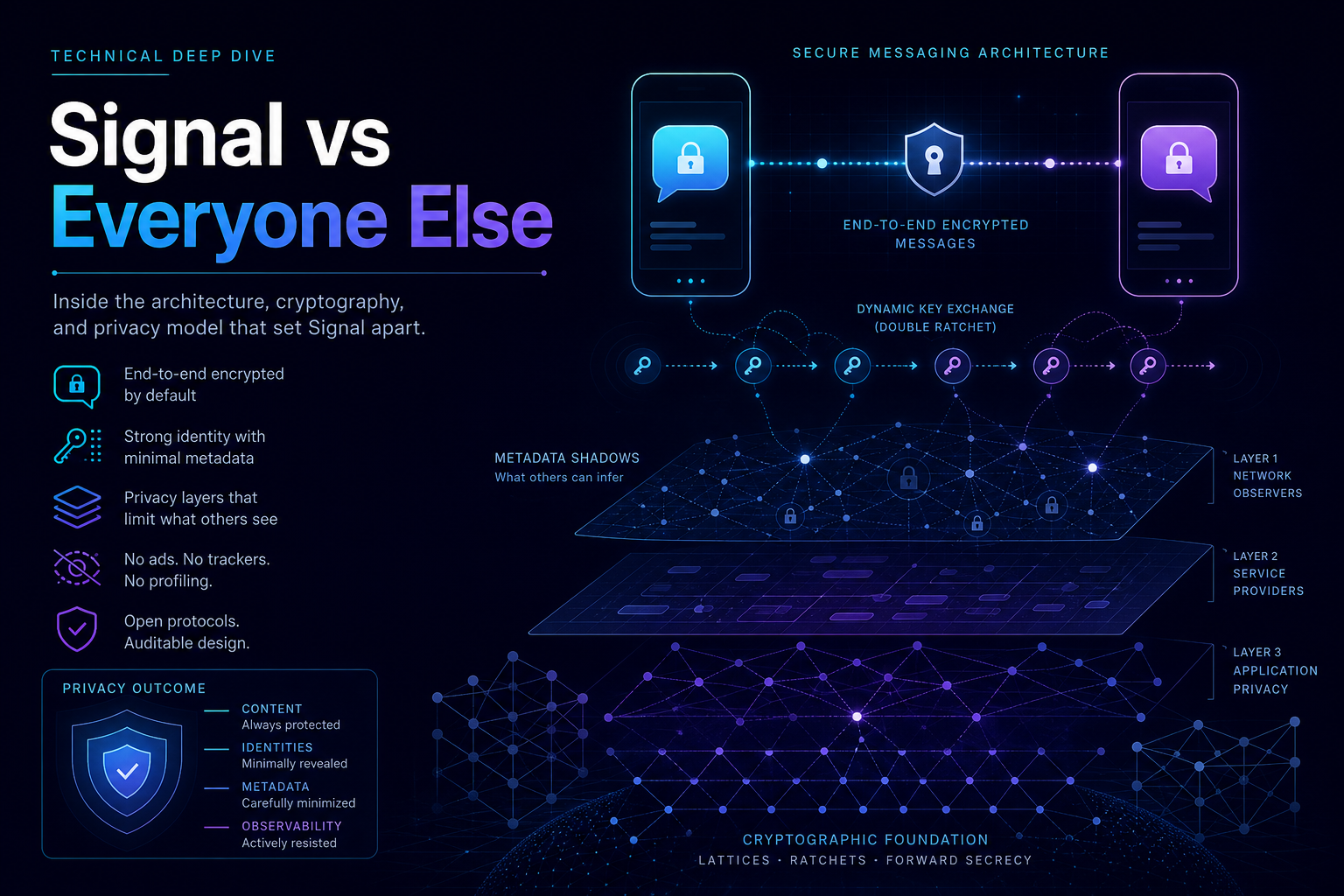
Signal vs Everyone Else
What Happened
Secure messaging is easy to describe and hard to evaluate. Most apps can say "encrypted," but that word hides several separate questions:
- Is encryption enabled by default?
- Who can read message content?
- What metadata remains visible?
- Are backups protected the same way as messages?
- Can independent researchers inspect the protocol?
Signal remains the reference point because its design is documented in public specifications, including the Double Ratchet and PQXDH protocols. The comparison gets more interesting when you place Signal next to Telegram, WhatsApp, Apple Messages and iCloud, and newer designs like SimpleX.
The short version: Signal is not magic, and it does not eliminate every form of metadata. It does reduce what the service is built to know, and it makes end-to-end encryption the ordinary path rather than a special mode.
Why It Matters
Privacy is not a single feature. It is a stack of defaults.
An app can encrypt content but still expose social graphs. It can protect chats but leave cloud backups readable. It can offer private modes while making the less private mode the default. It can hide phone numbers in the interface while still requiring a phone number for registration.
Those distinctions matter because users do not live in protocol diagrams. They live in defaults, recovery flows, notification settings, contact discovery, and backup prompts.
For Oxygen AI, this is also a useful lesson for trustworthy interfaces. Security is partly cryptography and partly product behavior. The safest design is the one where the normal path is also the protected path.
Signal's Baseline
Signal messages are end-to-end encrypted by default. The protocol combines asynchronous key agreement, ratcheting keys, and forward secrecy so a message compromise does not automatically reveal the full conversation history.
Signal has also been adding post-quantum protection through PQXDH, which mixes a post-quantum key encapsulation mechanism with the existing X3DH-style handshake. That does not make Signal invincible. It does show that the protocol is being updated for long-term risk, not just present-day threats.
The metadata story is more nuanced.
Signal still requires a phone number to register. Usernames can help keep phone numbers out of many user-facing interactions, but registration is not anonymous in the strongest possible sense. Signal's stronger claim is metadata reduction: sealed sender, minimal server knowledge, and a service architecture that tries to avoid retaining more than it needs.
That is different from saying "no metadata exists." Network timing, device state, push notification systems, and abuse-prevention machinery all create hard edges. Good privacy writing should name those limits.
Telegram Is A Different Default
Telegram is often discussed in the same breath as Signal, but its default model is different.
Telegram's FAQ distinguishes between Cloud Chats and Secret Chats. Cloud Chats are encrypted between the user and Telegram's servers so they can sync across devices. Secret Chats are end-to-end encrypted, but they are a separate mode and do not use Telegram's cloud sync model.
That choice may be convenient, but it changes the trust boundary. If the default path depends on the service being able to store and sync conversation content, then the service is part of the privacy model in a way Signal tries to avoid.
This is not a moral judgment. It is an architecture difference.
WhatsApp Uses Strong Protocols With A Broader System
WhatsApp's encryption overview describes end-to-end encryption built from Signal Protocol concepts. For everyday message content, that is a strong technical baseline.
The broader system is where the tradeoffs live. WhatsApp is tied to a large social platform, supports business messaging features, and has historically made backup behavior a separate area to understand. End-to-end encrypted backups are available, but backup protection is something users and platforms still need to reason about explicitly.
The lesson is that a strong message protocol does not automatically answer every product question. Account identity, contact discovery, abuse systems, cloud backup defaults, and parent-company incentives all shape the final privacy surface.
Apple Messages And iCloud Are Split By Context
Apple's security model is strongest when Advanced Data Protection is enabled for iCloud. Apple's iCloud data security overview explains which categories use standard data protection and which can use end-to-end encryption under Advanced Data Protection.
That matters because people often say "iMessage is encrypted" and stop there. Message transport and cloud storage are related but not identical. If messages are synced or backed up through a cloud account, the protection level depends on the exact setting and data category.
Apple has made important moves toward stronger default security, but the system still asks users to understand the difference between device messaging, cloud sync, account recovery, and backup protection.
SimpleX Pushes On Identity
SimpleX takes a more radical stance: it tries to avoid persistent user identifiers. Its documentation describes a design where communication uses pairwise addresses instead of global account identifiers.
That is an important privacy idea. A lot of metadata comes from stable identity: who has an account, who contacts whom, and which relationships persist over time. Reducing stable identifiers can reduce correlation risk.
The tradeoff is usability and ecosystem maturity. Identity-light systems can be harder to discover, recover, moderate, and explain. That does not make them wrong. It makes them a different point in the design space.
Bryan's Take
The most useful comparison is not "which app wins?" It is "what does each app make normal?"
Signal makes end-to-end encryption normal. It makes a smaller service knowledge footprint normal. It publishes protocol details and designs around reduced metadata. Its limits are real: phone-number registration, network-level observability, and the ordinary risks of endpoints and backups.
Telegram makes cloud sync normal, with private chats available as a special mode.
WhatsApp makes Signal-style message encryption normal inside a broader platform environment.
Apple makes strong security possible, especially with Advanced Data Protection, but the protection level depends on account and cloud settings.
SimpleX makes identifier minimization central, with usability tradeoffs that come from that choice.
For builders, the lesson is bigger than messaging. Trustworthy software is not only about the strongest primitive. It is about making the safer behavior the path of least resistance.
What I Am Watching Next
- Post-quantum upgrades moving from research language into ordinary app protocols.
- More work on metadata resistance that does not make products unusable.
- Backup and recovery flows that are secure without making users choose between privacy and losing their history.
The privacy frontier is not just better math. It is better defaults.