Next.js Went Rust
Next.js Went Rust
What Happened
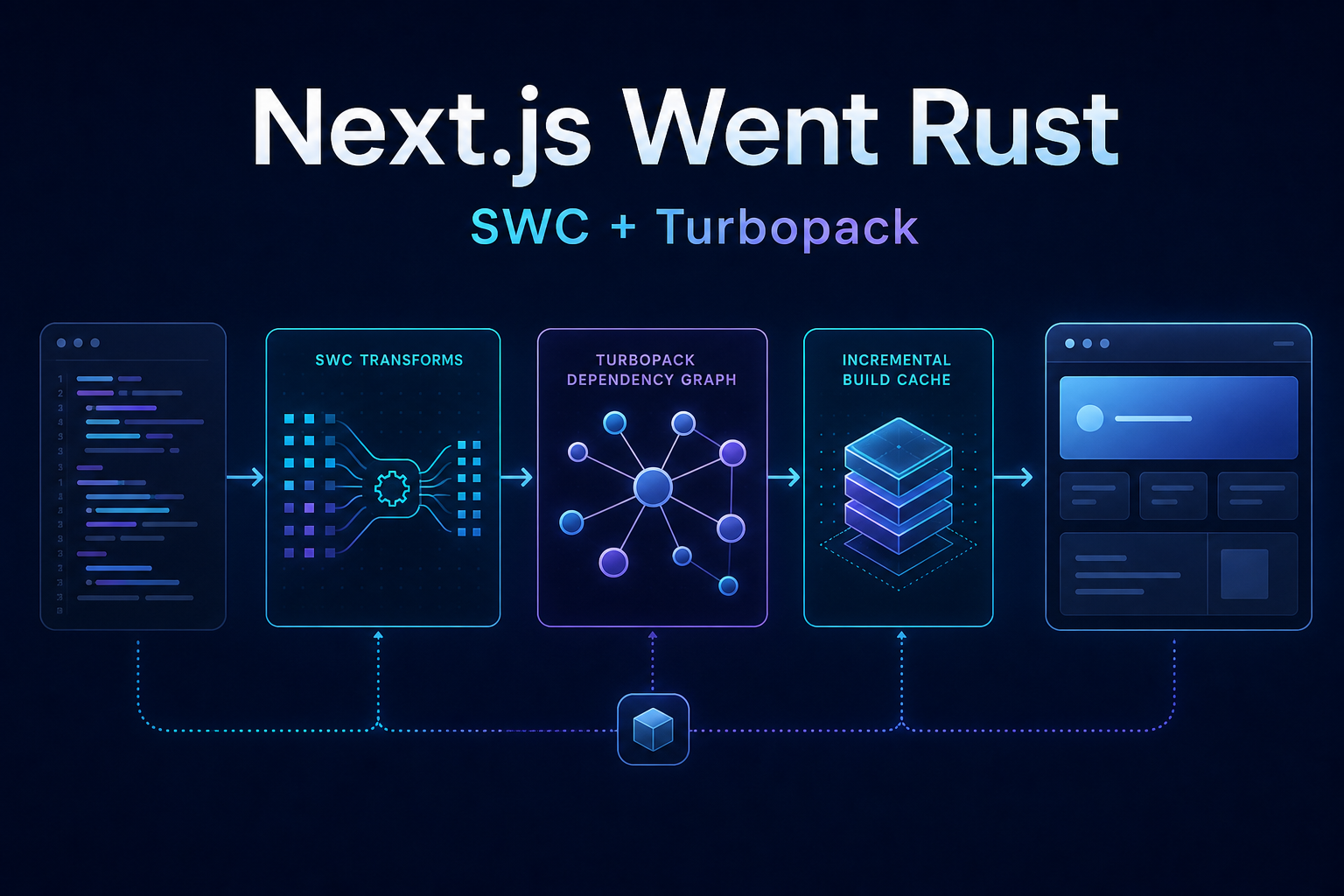
Next.js has been moving more of its build pipeline into Rust for several years. The Next.js Compiler is built on SWC, and it replaced the older Babel and Terser paths for many default transforms, minification, and framework-level compilation work.
With Next.js 16, the direction is even clearer: Turbopack is now the default bundler. Vercel describes Turbopack as a Rust-based successor to Webpack designed around incremental computation, faster local feedback, and tighter integration with the App Router.
The practical shift is not "Rust makes everything magically fast." The more grounded claim is that the framework is putting its hottest compiler and bundler paths into a systems language with predictable performance and a data model built for incremental work.
Why It Matters
Frontend teams experience framework performance as waiting.
Waiting for the dev server to start. Waiting for a route to refresh. Waiting for a production build to finish. Waiting for a bundle analyzer to tell you why a page grew.
Those delays change how people build. Slow tools make developers batch changes, avoid experiments, and stop checking the small details. Fast tools make it easier to stay in the loop.
That is the part I care about for AI systems too. If a product uses agents, memory stores, model routes, eval dashboards, and human approval screens, the interface needs to remain easy to inspect. Slow feedback pushes complexity into the shadows.
Rust-based tooling is not the product. It is the scaffolding that helps builders keep the product understandable.
SWC And Turbopack Are Different Pieces
It is useful to separate the two names.
SWC is the compiler layer. It parses and transforms JavaScript and TypeScript, handles framework-specific compilation, and powers minification in the default Next.js path.
Turbopack is the bundler layer. It tracks the dependency graph, decides what needs to be rebuilt, and serves updates during development. Its value comes from caching and invalidating the smallest useful amount of work.
Together, they represent a broader bet: modern web frameworks should own more of the toolchain so the compiler, router, bundler, and runtime can cooperate.
That trade has benefits and risks. The benefit is a tighter default path with fewer moving pieces. The risk is that custom build assumptions can break as the framework becomes more integrated. For teams with unusual transforms, plugins, or legacy Babel behavior, upgrades still deserve careful testing.
Bryan's Take
The interesting lesson is not only that Next.js chose Rust. It is that tooling is becoming infrastructure.
For Oxygen AI, that matters because AI applications are already operationally dense. A simple app can quickly include streaming UI, retrieval, background jobs, provider routing, tracing, evals, and approval flows. The framework cannot remove that complexity, but it can make the edit-test-build cycle less punishing.
I want tools that make careful work easier:
- Faster feedback when changing interface boundaries.
- More predictable builds when deploying small experiments.
- Clearer defaults so infrastructure choices do not leak into every feature.
Next.js 16 is a signal that the frontend stack is still being rebuilt from below. The best version of that story is not speed for its own sake. It is speed that gives builders enough room to think.
What I Am Watching Next
- How Turbopack behaves on larger App Router codebases with real route groups, images, MDX, and server-only modules.
- Whether framework-integrated build systems make observability and debugging clearer or more opaque.
- How much of the old plugin ecosystem still matters as Rust-native defaults become stronger.
The direction feels right. The standard is simple: faster tools should make production systems easier to understand, not harder to explain.