How MiniMax M3 Cheats the Quadratic Wall: Sparse Attention That Feels Like Mamba
How MiniMax M3 Cheats the Quadratic Wall: Sparse Attention That Feels Like Mamba
The subscription dance is real.
You drop everything, hold out for a while, then eventually resubscribe to Cursor (or whatever the current fastest interface is) because the raw workflow speed is just too painful to give up. It’s the classic developer cycle right now.
But when you’re actually running 16 agents continuously in the background, you can’t rely on standard API pricing. At that volume, token costs stop being a line item and become a structural barrier to the architecture you actually want to build.
This is exactly why MiniMax M3 is turning heads.
Its responses feel as coherent and “infinite” as a State Space Model (Mamba, Nemo, etc.) while still being a Transformer. They didn’t abandon the Transformer. They just completely re-engineered how it reads memory.
They call it MiniMax Sparse Attention (MSA).
The Quadratic Wall
In a normal dense Transformer, attention is O(N²). Every new token has to attend to every previous token in the KV cache. At 1 million tokens this becomes brutally expensive — both in compute and in memory bandwidth.
State Space Models solve the speed problem by compressing the entire past into a hidden state, but that compression can blur or lose precise details, especially across a massive codebase.
MiniMax wanted both: the sharp, uncompressed recall of a Transformer and near-linear scaling.
How MSA Actually Works
MSA makes two big structural changes:
1. Fixed-Block Partitioning
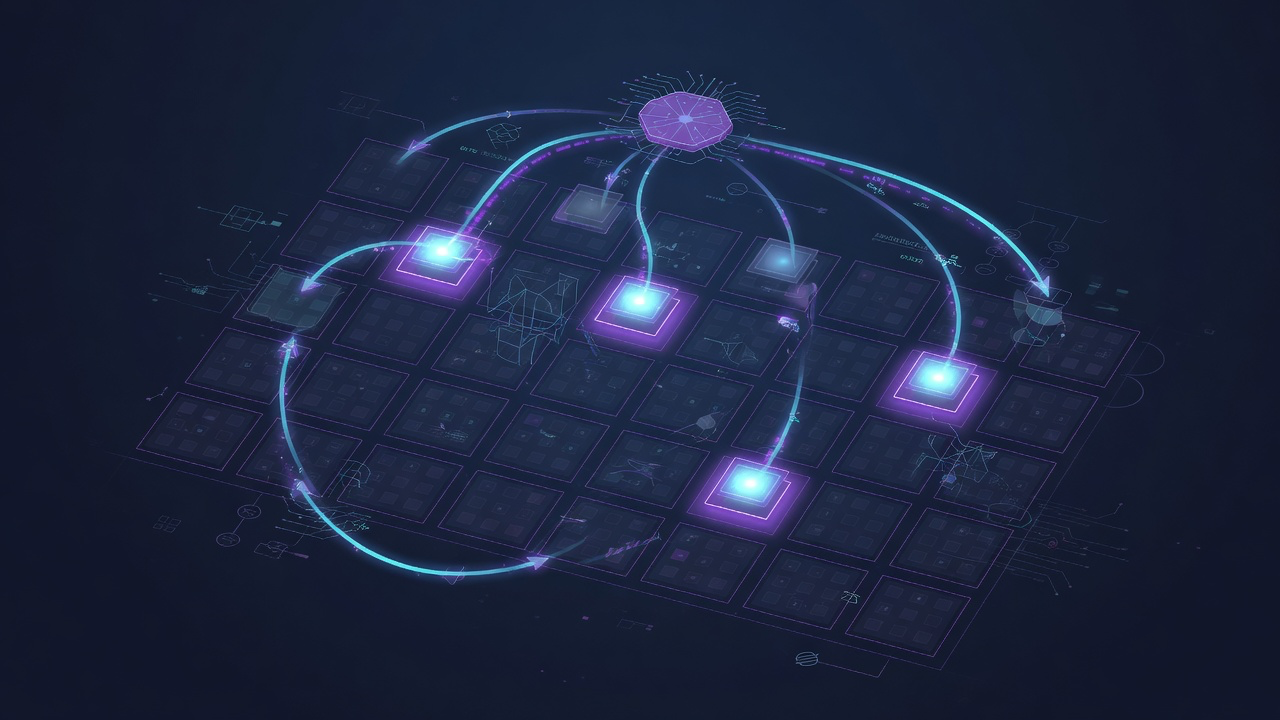
Instead of treating the entire context as one giant KV cache (or using lossy compression like some other approaches), MSA chops the cache into fixed, discrete blocks.
2. Lightweight Top-K Router
When generating the next token, a small, efficient routing layer looks at the blocks and selects only the Top-K most relevant ones for the current query. Everything else is ignored for that step.
Drop a 500-file repository into the context. The model isn’t reading all 500 files for every token it generates. If it’s writing a database migration, the router pulls the schema blocks and the relevant functions. The rest of the codebase stays cold in memory and costs zero compute for that step.
This is the key difference from classic sparse attention tricks. The routing is dynamic per token but extremely cheap.
The Hardware Trick That Actually Matters
The real win isn’t just algorithmic — it’s how they mapped it onto real GPU silicon.
Normally, sparse access patterns destroy memory locality and hammer High Bandwidth Memory (HBM). MiniMax engineered a KV-Block-Major memory layout. Relevant blocks get loaded into the GPU’s fast SRAM once, then all the queries that need that block are processed sequentially before the block is evicted.
The result:
- 9.7× prefill speedup
- Up to 15.6× faster decoding compared to their previous architecture
You get the fluid, long-horizon generation feel of linear models while retaining the precise, uncompressed memory access that coding agents actually need.
Why This Matters
For people running serious agent fleets (local or otherwise), this class of architecture is more important than another 5% on a benchmark.
It directly attacks the two things that currently break at scale:
- Context cost exploding with repository size
- The “blurry middle” problem that makes long-horizon agent work unreliable
If models like this become widely available (especially in open or self-hostable forms), the economics of running many specialized agents in parallel shift dramatically.
We’re not quite there yet on the fully open side, but the direction is clear: the next real leap in agent capability won’t come from making dense attention slightly more efficient. It will come from architectures that are designed from the start to only pay attention to what actually matters, at both the algorithmic and the silicon level.
MiniMax M3 is one of the cleanest examples of that thinking so far.
What do you think — is this the direction that actually unlocks reliable multi-agent systems at scale, or are we still missing something bigger on the memory/continual learning side?
Resources
- MiniMax M3 on Hugging Face
- MiniMax official site
- Technical report: arXiv:2606.13392 (via the model card)