Mage-Flow: Open Image Generation and Editing from Microsoft Research
Mage-Flow: Open Image Generation and Editing from Microsoft Research
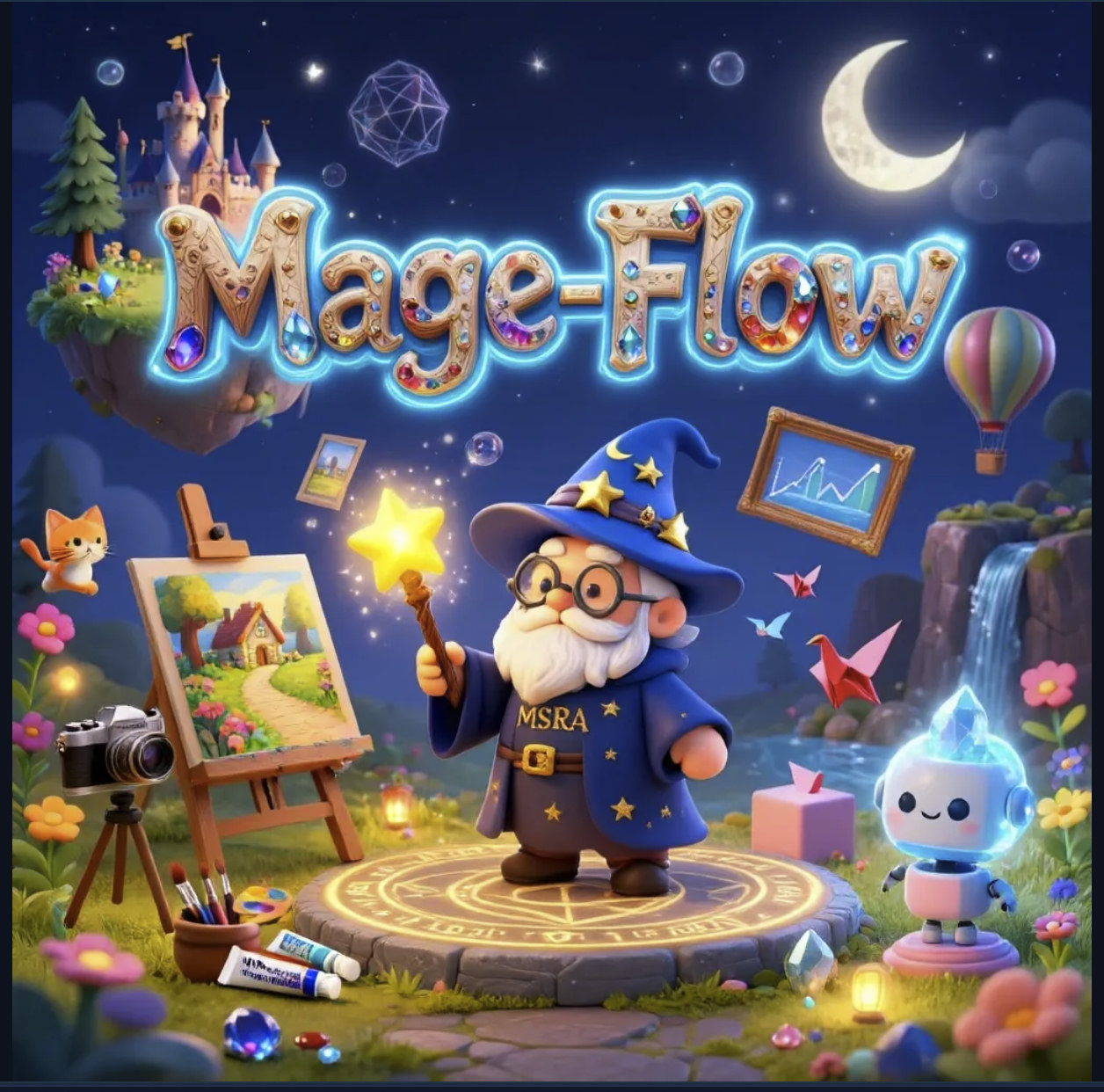
I stood up Mage-Flow locally—Microsoft Research’s open text-to-image and instruction-based image editing stack—and pushed a long, highly structured prompt. The result is the cover for this post.
Generated locally with Mage-Flow. The harder and clearer you write the prompt, the more the model holds scene structure, materials, and composition.
That is not a marketing still from the paper. It is a single generation from an open checkpoint, with an open pipeline, running on my own machine. For anyone who cares about local creative tools, efficient models, and not renting every pixel from a closed API, this release is worth attention.
Thank you, Microsoft—for shipping the code, the weights, and a real generation and editing family under an open license people can actually run.
What Mage-Flow Is
Mage-Flow is a ~4B-scale generative stack for:
- Text → image generation
- Instruction-based image editing (change the background, blend references, restore, restyle, and more)
Instead of racing to tens of billions of parameters, Microsoft Research’s write-up emphasizes tokenizer–backbone–system co-design: a lighter latent tokenizer, a shared native-resolution multimodal DiT, and packing tricks so one checkpoint can span resolutions and aspect ratios without a zoo of specialized models.
Reported building blocks (from the project docs / paper framing):
- Mage-VAE — a compact latent tokenizer (one-step diffusion encode/decode style with anchor-latent regularization), aimed at high-fidelity reconstruction without making the VAE the high-res bottleneck.
- NR-MMDiT — a shared native-resolution multimodal diffusion transformer, trained with rectified flow matching in Mage-VAE latent space.
- Native-resolution packing — variable-length image + text tokens, extreme aspect ratios (including roughly 4:1), and a single checkpoint for roughly 512–2048 on a side.
Paper and project links:
- arXiv:2607.19064
- Project page
- Code:
microsoft/Mage→mage_flow - Hugging Face (Mage-Flow* repos)
Those architectural claims are from Microsoft Research’s materials. My contribution here is the local stand-up, the UI, and the generation quality under a dense prompt—not a re-run of their full GenEval / DPG tables.
The Model Family
Each checkpoint is a self-contained diffusers-style repo (transformer/ + vae/ + text_encoder/ + scheduler/). There are six practical weights people will actually download:
| Model | Task | Variant | Typical steps |
|---|---|---|---|
microsoft/Mage-Flow-Base | text→image | Base | 30 |
microsoft/Mage-Flow | text→image | RL-aligned | 20 |
microsoft/Mage-Flow-Turbo | text→image | few-step distilled | 4 |
microsoft/Mage-Flow-Edit-Base | editing | Base | 30 |
microsoft/Mage-Flow-Edit | editing | RL-aligned | 30 |
microsoft/Mage-Flow-Edit-Turbo | editing | few-step distilled | 4 |
How to think about the rows:
- Base — foundation training; more steps, solid general quality.
- RL-aligned — preference / post-training pass; often the “best looking” full path for careful work.
- Turbo — ~4 steps, CFG near 1; the interactive default. Latency becomes usable for a local studio loop.
Editing is not a bolted-on controlnet toy. Mage-Flow-Edit is image-and-text conditioned: semantic edits, appearance shifts, scene/subject changes, restoration-style tasks, and multi-reference blends (drop more than one source when the instruction needs them).
On paper, Microsoft Research positions the 4B family as competitive with much larger open systems on standard generation and edit benchmarks. Treat leaderboard rows as reported claims until you reproduce them; what matters for builders is that the open weights exist, the API is simple (generate / edit), and Turbo is fast enough to iterate.
Prompt Quality Is the Multiplier
The cover image is not “lucky seed only.” It is what happens when you specify the scene like a director instead of a single mood word.
Dense prompts that work well with this stack tend to include:
- Global setting (time of day, palette, atmosphere)
- Exact hero subject (pose, costume details, props)
- Spatial layout (center, left, right, sky, foreground)
- Material language (gemstones, neon outline, stone runes, volumetric light)
- Style anchor (3D fantasy key art, game logo art, cinematic DOF)
The prompt used for the cover
A highly detailed, whimsical 3D fantasy digital illustration in a vibrant nighttime magical forest setting. Deep blue starry night sky filled with glowing stars, soft clouds, a crescent moon on the upper right, and floating geometric wireframe polyhedra and bubbles.
Centerpiece is a large, glowing, ornate 3D title “Mage-Flow” floating in the upper middle. The letters are thick, bubbly, and richly textured: filled with colorful crystals, gemstones, wooden carvings, paint splatters, and magical ornaments, all outlined in bright electric blue neon glow with soft bokeh light particles.
Below the title stands a cute, chubby elderly wizard as the main character. He has a long white beard, round glasses, a tall pointed blue wizard hat decorated with gold stars and a crescent moon, and a deep blue robe covered in gold stars with the letters “MSRA” embroidered in gold on the chest. He holds a wooden magic wand topped with a glowing yellow star, casting sparkling magical energy, floating photo frames, colorful flowers, and origami birds from his left hand. He stands on a circular stone platform etched with glowing golden magical runes and a pentagram-like circle.
Surrounding elements (clockwise from left):

A floating island with a fairy-tale castle and pine trees on the upper left.
An artist’s easel holding a sunny landscape painting of a path leading to a cottage among trees and flowers.
A wooden pot of paintbrushes, a colorful paint palette, and two paint tubes labeled “MSRA Magical Pigments” lying on the ground.
A vintage camera on a tripod to the far left.
Colorful wildflowers, glowing lanterns, and a small waterfall on rocky cliffs on the right side.
A cute pastel cube robot with a smiling face standing near a glowing blue crystal orb on a pedestal and an armillary sphere.
Floating objects throughout the sky: a vintage camera, an orange cat mid-jump, a colorful hot-air balloon, a framed seascape painting, a blue line-chart icon, pink and red origami cranes, and more geometric shapes.

Foreground is a mossy stone path with scattered gems, flowers, and magical particles. Soft volumetric lighting, rich saturated colors (deep blues, golds, magentas, greens), high detail, cinematic depth of field, cute cartoonish 3D style similar to high-end fantasy logo art or game key art.
Pushing harder on structure—title treatment, robe embroidery, easel painting, robot, cat, waterfall—does not “confuse” the model into mush when the hierarchy is clear. It fills the canvas. That is the difference between vibe prompting and composition prompting.
For Turbo, start with steps = 4 and CFG ≈ 1. For the RL generation checkpoint, steps ≈ 20 and CFG ≈ 5 is the project’s natural quality setting. Edits follow the same idea: short Turbo loops for exploration, longer RL/Base passes when fidelity matters.
Why Open Generation + Editing Matters
Closed image APIs are convenient. They are also meters, policy layers, and someone else’s latency budget.
An open stack that can both generate and edit under local control unlocks a different product shape:
- Private creative loops — reference photos never leave the machine.
- Composable workflows — generate, then edit, then edit again, without shipping every intermediate to a third party.
- Fine-tune and productize — 4B is in the range where labs and independents can actually adapt models, not only call them.
- Honest infrastructure — you see VRAM, steps, and failure modes instead of a black box spinner.
Mage-Flow’s editing path is especially important. Pure text-to-image is only half of modern creative work. Most real tasks are “keep this subject, change that context” or “blend A into B.” Instruction editing makes the model a tool, not a slot machine.
Local Notes (Apple Silicon)
I installed from the official mage_flow tree, pulled the full six-checkpoint family from Hugging Face, and ran a local Gradio studio on Apple Silicon (MPS) with the project’s SDPA attention fallback (flash-attn is CUDA-only).
Practical envelope on a 64 GB M4 Pro-class machine:
- Prefer Turbo for interactive exploration.
- Keep early tests around 1024² before going wide or multi-megapixel.
- Load models lazily; each checkpoint is on the order of ~16 GB on disk because every repo ships transformer + text encoder + VAE.
- Official CUDA numbers (A100 Turbo latency, peak memory tables) are their reported lab numbers, not what you should expect from MPS + SDPA.
Repo path I used:
~/projects/mageflow
./launch.sh   # local studio on http://127.0.0.1:7860
Python surface is straightforward:
from mage_flow import MageFlowPipeline

pipe = MageFlowPipeline.from_pretrained("microsoft/Mage-Flow-Turbo", device="mps")
img = pipe.generate(
    ["your long structured prompt"],
    steps=4, cfg=1.0, heights=[1024], widths=[1024],
)[0]
img.save("out.png")
Editing is the same pipeline class with pipe.edit(prompts, ref_images, ...).
Limitations (Be Honest)
- Hardware — full-quality paths want serious memory; Turbo is the friendly entry, not a free pass on every resolution.
- Safety gates — the open pipeline includes content screening on prompts (and edit sources). Expect refusals on disallowed content; that is intentional, not a bug.
- Not a free FLUX/Qwen clone — quality is strong for the size class, but taste is personal; always compare against your own references.
- Apple Silicon is adapted, not first-class in the README — CUDA + flash-attn is the upstream happy path; MPS uses SDPA and may be slower or quirkier on some ops.
What’s Next
I am still deep in this Mage-Flow setup, and the results above are why. Separately, I am expecting to try the new Flux image and video generation model when it drops—same kind of hands-on local (or as-local-as-possible) evaluation, same honest write-up. Open generative stacks are moving fast on both stills and motion; Mage-Flow is a strong open image/edit checkpoint today, and Flux’s next image + video release is the other train I am waiting on at the station.
Takeaway
Microsoft Research shipping a full open family—Base, RL, Turbo, and matching Edit twins—is a real move for the open creative stack. You get generation and instruction editing under one design, native resolution range, and weights you can host yourself.
The cover image is my proof of life: when you treat the prompt like a shot list, Mage-Flow can hold a crowded fantasy composition with legible logo type, character costume detail, and secondary props without collapsing into soup.
If you are already building local studios, agent tools, or private media pipelines, this is a model family worth downloading, not just bookmarking.
Again: thank you, Microsoft, for putting this in the open.