Holo3.1 and Desktop Vision Agents
Holo3.1 and Desktop Vision Agents
What Happened
H Company released Holo3.1-35B-A3B, the largest checkpoint in its Holo3.1 family of vision-language models for computer-use agents.
The model card frames Holo3.1 as a VLM family for navigation and computer use across web, desktop, and mobile environments. The family includes 0.8B, 4B, 9B, and 35B-A3B models, with the 35B-A3B checkpoint listed as Apache 2.0 and available in BF16, FP8, NVFP4, and Q4 GGUF forms. The quickstart describes the 35B-A3B model as having 35B total parameters with 3B active parameters.
The active-parameter detail is the signal. This is not just another dense model release. It is a computer-use model pointed at screenshots, UI grounding, function calls, and local deployment, with a mixture-style footprint designed to keep each inference step lighter than the full parameter count implies.
What the Architecture Signals
Holo3.1 sits at the intersection of two directions that feel increasingly important.
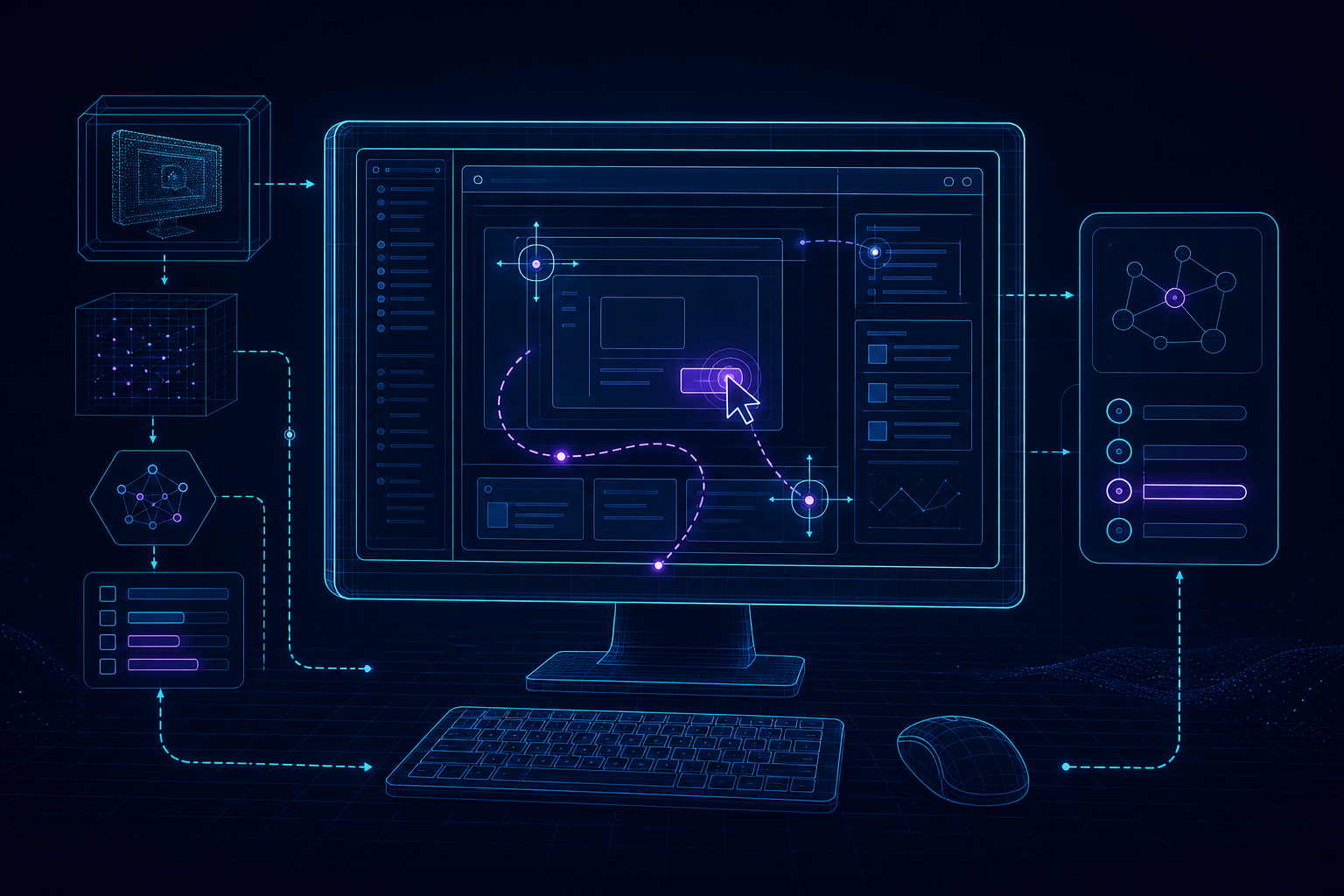
The first is vision as an action interface. Holo is not presented as a general chat model that happens to accept images. H Company describes two main usage patterns in its quickstart:
- An agent loop, where conversation plus screenshots produce the next tool call.
- Element localization, where a target description and screenshot produce coordinates in a normalized range.
That is a different center of gravity. The model is being aimed at the messy interface layer where agents need to read screens, decide what changed, identify controls, and issue actions through a harness.
The second is efficient active computation. The Hugging Face sidebar lists the checkpoint as 35B parameters, while the quickstart lists 3B active parameters for Holo3.1-35B-A3B. That makes the release part of a broader pattern: models that are not only smaller, but more selective about which parameters are used on a given step.
This is not a leaderboard note. The interesting thing is the architecture direction. Holo3.1 points toward agents that can run closer to the user, act through ordinary interfaces, and use specialized visual grounding rather than treating every task as text completion.
Why It Matters
Desktop action agents live or die on practical system details.
A model has to understand a screen. It has to ground an instruction to a visible control. It has to preserve state across steps. It has to call tools in the format the agent harness expects. It has to run quickly enough that a multi-step task does not feel broken before it finishes.
H Company claims Holo3.1 improves robustness across web, desktop, and mobile environments, adds native function-calling support in addition to structured JSON outputs, and expands local deployment through quantized checkpoints. In the linked release post, H Company reports that the 35B-A3B model improves on AndroidWorld from 67% to 79.3%, and that smaller 4B and 9B variants improve from 58% to 71%. It also says FP8 and NVFP4 land roughly two OSWorld points under BF16, while NVFP4 reaches 1.41x the token throughput of FP8 and 1.74x BF16 on DGX Spark.
Those are reported claims from H Company, not independent measurements. Still, the shape of the claim is useful: the frontier for agents is not only "can the model reason?" It is "can the whole loop see, decide, act, and recover in the environment where the work actually happens?"
Trustworthy Desktop Agents
The benchmark story is interesting, especially because H Company compares Holo3.1 against the Qwen 3.5 family and presents it as a strong performance-per-inference-step tradeoff. The larger question is architectural: what does it take to make a desktop agent trustworthy enough to use?
A computer-use agent needs more than a good next action. It needs visible state, clear permissions, an understandable action log, recoverable mistakes, and memory that can explain why it is being used. The more direct access a model has to the desktop, the more the surrounding system has to make supervision natural.
That is what makes Holo3.1 worth watching. It points at a future where the model is only one layer of the product. The agent harness, UI grounding, permission model, memory layer, and local runtime all matter just as much.
What To Watch Next
A useful experiment would start in a constrained environment: a sandboxed desktop, non-sensitive files, explicit tool permissions, and a visible action log. The first question is not whether it can complete a flashy demo. The first question is whether it can stay grounded and inspectable when the screen changes.
The details I would watch:
- Whether element localization stays reliable across real application layouts, not only clean benchmark screens.
- Whether function calling makes agent traces easier to inspect than plain JSON action strings.
- Whether Q4 GGUF is practical enough for local experiments on consumer hardware.
- Whether the 3B-active design gives useful latency without losing the precision needed for UI tasks.
- Whether safety boundaries can be made product-native rather than bolted on after the model acts.
There is a small source wrinkle worth noting: the model card text says the family is based on Qwen 3.5, while the raw metadata lists Qwen/Qwen3.6-35B-A3B for the largest checkpoint. I would treat that as a documentation detail to verify before making deeper claims about lineage.
For now, the important signal is clear enough. Desktop agents are moving from demos toward architecture: vision grounding, action protocols, local inference, active-parameter efficiency, and interfaces that let a person supervise the system while it works.