Gemma 4 12B Unified
Gemma 4 12B Unified
What It Is
Google released Gemma 4 12B-it, the instruction-tuned 12B member of the Gemma 4 family. It is open-weight, has 11.95B parameters, and supports a 256K-token context window. It accepts text, image, and audio input and generates text output, and the model card lists multilingual support across more than 140 languages.
It is good news that Google keeps shipping these into the open, with both pre-trained and instruction-tuned variants and accessible licensing.
The "Unified" Design
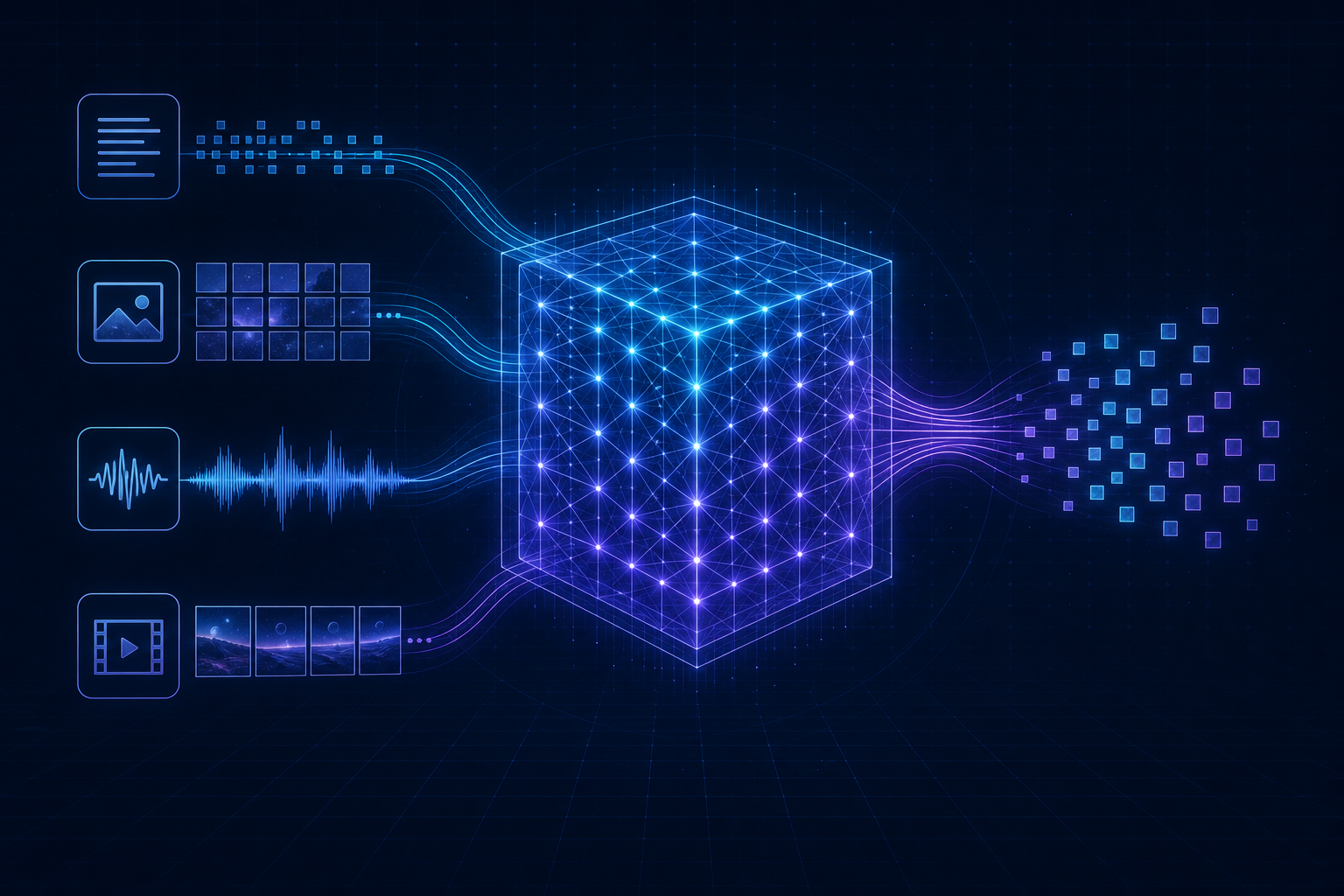
The "Unified" label points to how the 12B handles multiple input types. The smaller Gemma 4 models (E2B, E4B) carry separate vision and audio encoder parameters; the model card lists those encoder rows as empty for the 12B. Vision, audio, and text run through the same weights rather than through bolted-on encoders in front of the language model.
Architecturally, Gemma 4 uses a hybrid attention scheme that interleaves local sliding-window attention with full global attention, with the final layer always global. To keep memory in check over long contexts, the global layers use unified keys and values and apply Proportional RoPE (p-RoPE).
It Fits in 16GB of RAM
At full BF16 precision the weights are roughly 24GB, which is more than a 16GB machine can hold. Quantization closes the gap, and 4-bit is well-established at this point: Google's earlier Gemma 3 QAT (quantization-aware training) checkpoints produced int4 weights that held quality close to half precision while using about three times less memory.
A 4-bit build of a 12B model lands around 6.5 to 7.5GB of weights. On an Apple Silicon Mac, where the 16GB of memory is unified between CPU and GPU, that leaves room for the runtime and a working context window. Because the 12B carries no separate vision or audio encoder, it is one set of weights to load rather than a model plus encoders. Google points the 12B at laptops directly through Google AI Edge, LM Studio, and Ollama.
The practical ceiling on a 16GB machine is usually the context, not the weights: the model can address 256K tokens, but the key/value cache grows with the input, and that memory comes out of the same 16GB.
Running It Locally
The fastest path needs no setup beyond a download:
- Ollama or LM Studio pull a quantized build and run it behind a local chat or an OpenAI-compatible endpoint, which is the simplest way to get a 4-bit Gemma 4 12B answering on a laptop.
- MLX runs the model natively on Apple Silicon and tends to make the most of the unified memory on a Mac.
- llama.cpp loads GGUF builds directly if you want to wire it into your own tooling.
- Google AI Edge is Google's own on-device path for the 12B.
A reasonable default on a 16GB Mac is a 4-bit quantization with a context window you actually need rather than the full 256K, leaving headroom for the key/value cache.
What the Benchmarks Show
The reported numbers are the headline. The 12B Unified posts results well above its parameter count: across the instruction-tuned comparisons it beats the previous-generation Gemma 3 27B (no think) on essentially every row despite being less than half the size, for example 77.2% vs 67.6% on MMLU Pro, 78.8% vs 42.4% on GPQA Diamond, and 77.5% vs 20.8% on AIME 2026. It also lands close to the larger Gemma 4 31B and 26B A4B models on several reasoning, vision, and long-context tasks. For a model that fits on a laptop, that is a lot of capability per parameter.
The full comparison from the model card is below.
Toward Utility Intelligence
The "Unified" part is the thread worth pulling. One model that sees, hears, and reads through the same weights is a small step toward AI as omni-modality: not a text box you visit, but an intelligence that takes the world in whatever form it arrives. That is the version most people will actually care about. Few will ever pick a model or tune a sampler, but everyone notices when something just works across whatever they point at it.
Utility is the other half. The things people lean on are the ones that are simply present, fast, and free of friction, the way power and water are. A capable multimodal model that fits on the laptop you already own, runs without a meter, and answers in any modality is what that future starts to look like. Releases like this one move it a little closer, and putting them in the open lets everyone build on top. That is worth being glad about.
Stats From the Model Card
Benchmark results reported by Google for the instruction-tuned models.
| Benchmark | Gemma 4 31B | Gemma 4 26B A4B | Gemma 4 12B Unified | Gemma 4 E4B | Gemma 4 E2B | Gemma 3 27B (no think) |
|---|---|---|---|---|---|---|
| Reasoning & Knowledge | ||||||
| MMLU Pro | 85.2% | 82.6% | 77.2% | 69.4% | 60.0% | 67.6% |
| AIME 2026 (no tools) | 89.2% | 88.3% | 77.5% | 42.5% | 37.5% | 20.8% |
| LiveCodeBench v6 | 80.0% | 77.1% | 72.0% | 52.0% | 44.0% | 29.1% |
| Codeforces ELO | 2150 | 1718 | 1659 | 940 | 633 | 110 |
| GPQA Diamond | 84.3% | 82.3% | 78.8% | 58.6% | 43.4% | 42.4% |
| Tau2 (average over 3) | 76.9% | 68.2% | 69.0% | 42.2% | 24.5% | 16.2% |
| HLE (no tools) | 19.5% | 8.7% | 5.2% | - | - | - |
| HLE (with search) | 26.5% | 17.2% | - | - | - | - |
| BigBench Extra Hard | 74.4% | 64.8% | 53.0% | 33.1% | 21.9% | 19.3% |
| MMMLU | 88.4% | 86.3% | 83.4% | 76.6% | 67.4% | 70.7% |
| Vision | ||||||
| MMMU Pro | 76.9% | 73.8% | 69.1% | 52.6% | 44.2% | 49.7% |
| OmniDocBench 1.5 (edit distance, lower is better) | 0.131 | 0.149 | 0.164 | 0.181 | 0.290 | 0.365 |
| MATH-Vision | 85.6% | 82.4% | 79.7% | 59.5% | 52.4% | 46.0% |
| MedXPertQA MM | 61.3% | 58.1% | 48.7% | 28.7% | 23.5% | - |
| Audio | ||||||
| CoVoST | - | - | 38.5* | 35.54 | 33.47 | - |
| FLEURS (lower is better) | - | - | 0.069* | 0.08 | 0.09 | - |
| Long Context | ||||||
| MRCR v2 8 needle 128k (average) | 66.4% | 44.1% | 43.4% | 25.4% | 19.1% | 13.5% |
*Excluding Chinese language.
Thanks, Google.