Curvature Tensors Need Better Pictures
Curvature Tensors Need Better Pictures
I uploaded the paper here: Physical and Geometric Interpretations of the Riemann Tensor, Ricci Tensor, and Scalar Curvature.
The paper is by Lee C. Loveridge, and its purpose is refreshingly direct: explain what the important curvature objects in general relativity mean, not just how to manipulate their indices.
That is the kind of paper I like reading slowly.
The Gap It Tries To Fill
The introduction makes a useful comparison. Electromagnetism is often taught with intuitive pictures before the formal machinery arrives. You can learn that charges source electric fields, currents circulate magnetic fields, and Maxwell's equations eventually sharpen those ideas.
General relativity is often not taught that way.
You either get the popular picture of rubber sheets and bent space, or you get graduate-level tensor notation. The middle layer is thinner than it should be.
Loveridge is trying to fill that middle layer for the Riemann tensor, Ricci tensor, scalar curvature, Einstein tensor, and Einstein's equations.
Riemann: Curvature As Local Deviation
The Riemann tensor gets several interpretations in the paper, but the one that sticks is this: it measures how local geometry deviates from flat expectations.
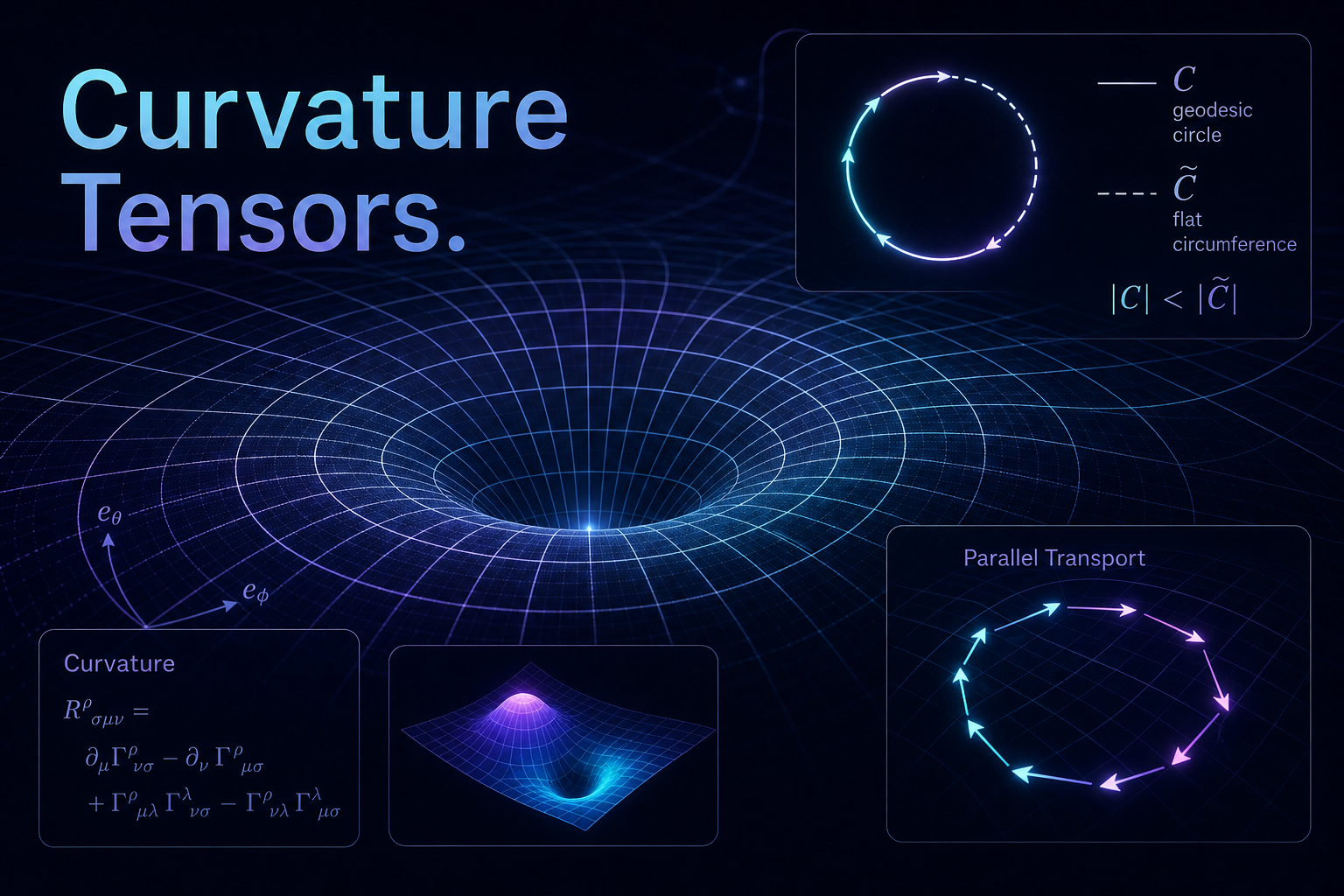
On a two-dimensional surface, Gaussian curvature can be understood by drawing a tiny geodesic circle and comparing its circumference to the flat-space circumference. In flat space, a circle of small radius has circumference 2πr. In curved space, the circumference is slightly larger or smaller.
That deviation is the signal.
The Riemann tensor generalizes that idea. Choose two directions. They define a small two-dimensional plane inside the space. The Riemann tensor tells you the Gaussian curvature of that plane, scaled by the area of the parallelogram made by those directions.
That is more useful than thinking of Riemann as a wall of indices. It is a collection of local curvature measurements across possible two-dimensional slices.
Ricci: What Happens To A Small Volume
The Ricci tensor is usually introduced as a contraction of the Riemann tensor. That is true, but it is not satisfying by itself.
The paper's physical interpretation is better: Ricci curvature governs how a small volume of freely moving test particles changes as it moves along a geodesic, after subtracting the volume change that would have happened even in flat space.
Riemann describes relative acceleration between nearby geodesics.
Ricci describes the volume-level consequence of those relative accelerations.
That shift matters. It moves the idea from "a tensor contraction happened" to "a cloud of nearby particles focuses or spreads differently because the space is curved."
Scalar Curvature: Boundary Area As A Curvature Signal
Scalar curvature is the next contraction, but again the paper gives it a picture.
Imagine the set of all points a tiny geodesic distance away from a starting point. In flat space, that boundary has a predictable area. In curved space, the area deviates from the flat expectation.
Scalar curvature measures that deviation.
So the progression is:
- Riemann: curvature of directional two-dimensional slices.
- Ricci: volume deviation along a direction.
- Scalar curvature: total boundary-area deviation around a point.
That is the kind of ladder I want in my head when reading equations.
Einstein's Equation As A Geometric Statement
The paper then connects these interpretations to the Einstein tensor and Einstein's equations.
One of the useful frames is that, once a time direction is chosen, the Einstein tensor tells us about the scalar curvature of the corresponding spatial dimensions. Contracting Einstein's equation with a timelike vector connects that spatial curvature to energy density.
In plain language: energy density is not just something sitting inside space. It is tied to the curvature of the spatial geometry seen by an observer.
That is the sentence version of the equation.
Why This Matters To Me
I keep coming back to physics because it gives names to things that software often leaves vague.
Curvature is not just a metaphor. It is a disciplined way of asking: how does local behavior deviate from the expectation we would have in a flat, simple world?
That question shows up in AI systems too.
- How does an agent's behavior deviate after memory is added?
- How does a small correction change the future trajectory?
- How does the system's local response reveal the larger geometry of its learned behavior?
- When does a set of interactions begin to focus, drift, or spread?
I do not mean that the Riemann tensor directly solves agent alignment. It does not. But the habit of looking for geometric meaning under formal machinery is extremely useful.
The paper is a reminder that a good explanation does not weaken the math. It makes the math usable.
My Working Takeaway
When I read physics, I am looking for transferable habits:
- Turn formal objects into measurable deviations.
- Separate coordinate artifacts from real effects.
- Prefer invariant pictures over surface notation.
- Ask what changes when a small object moves through the system.
- Connect local behavior to global structure.
That is why this paper belongs in my notes. It is not just about general relativity. It is about learning to see structure.